


Views: 0 Author: Site Editor Publish Time: 2026-06-25 Origin: Site


Resistance welding offers an incredibly efficient way to join metals without requiring any filler materials. However, this streamlined process relies heavily on precision and exact mechanical control. It places the entire burden of process stability squarely on the electrode. When you choose the wrong consumable, the consequences ripple across your shop floor immediately. Poor electrode selection inevitably leads to excessive downtime for tip dressing. It compromises your final weld integrity and drastically inflates your overall consumable costs.
You cannot afford to guess when specifying these critical components for high-volume manufacturing. In this guide, you will learn how to build an engineering-driven decision matrix. We will help you match electrode material, geometry, and operational parameters directly to your specific production environment. You will discover how to balance thermal physics, like conductivity matching, against daily shop-floor realities. By understanding mechanical deformation and cooling limits, you can ensure optimal weld performance every single cycle.
The Inverse Conductivity Rule: Electrode material must complement the workpiece—high-resistance metals require highly conductive copper alloys, while highly conductive base metals require refractory electrodes (tungsten/molybdenum) to force heat generation.
Cost-Optimized Tooling: Transitioning from solid straight electrodes to cap-and-shank configurations separates the consumable wear surface from the reusable structural mount, significantly lowering long-term operational costs.
Operational Discipline is Critical: Excessive pneumatic descent speeds and inadequate cooling (rather than normal thermal cycling) are the primary drivers of premature electrode "mushrooming" and failure.
Vendor Scalability: Partnering with a compliant, traceable Resistance Welding Electrode manufacturer ensures consistent alloy composition and strict adherence to RWMA/ISO standards.
Before diving into specific alloys, engineers must establish the baseline physical requirements for their application. Any shortlisted Resistance Welding Electrode must fulfill three distinct operational roles flawlessly. Failing to meet even one of these mandates will result in weak joints or catastrophic consumable failure.
Every successful welding operation relies on these Three Engineering Mandates:
Electrical: The electrode must maintain a highly uniform current density. This establishes precise contact resistance at the joint interface. If current density fluctuates, weld penetration becomes dangerously inconsistent.
Mechanical: It must contain the molten nugget under extreme forging pressure. Soft materials will yield or deform under this pressure, compromising the structural integrity of the weld.
Thermal: It must act as a highly efficient heat sink. The electrode must extract waste heat immediately after the weld cycle completes. This rapid cooling prevents the copper surface from alloying with or sticking to the workpiece.
Beyond these mandates, you must follow the Golden Sizing Rule. The physical diameter of the electrode face strictly constrains the maximum possible weld nugget size. You cannot create a weld larger than your contact area. Therefore, you must always deliberately size the contact area slightly larger than your target nugget diameter. This ensures adequate heat dissipation and prevents surface expulsion.
Selecting the correct alloy requires a concrete decision framework. You must base this framework entirely on the metallurgical properties of the metal you intend to weld. The industry relies on the "Inverse Conductivity Rule" to achieve optimal thermal balance.
Metals like stainless steel, low-carbon steel, and Monel possess high natural electrical resistance. They generate heat rapidly when current passes through them. For these target materials, your electrode solution requires high-conductivity alloys. You need a high IACS (International Annealed Copper Standard) percentage to prevent the electrode itself from overheating and melting.
Standard material choices include RWMA Class 1 or Class 2 copper alloys. Class 2, primarily Chromium Copper, serves as the universally accepted industry standard for joining steel. However, engineers must remember a critical warning. These precipitation-hardened alloys will permanently lose their high conductivity if they suffer thermal abuse from inadequate water cooling.
Metals such as copper, aluminum, or gold-plated components present the opposite challenge. They dissipate heat so rapidly that forming a molten nugget becomes incredibly difficult. Your electrode solution here requires low-conductivity refractory metals. These specialized materials generate supplemental heat right at the tip. This forced heat compensates for the rapid heat dissipation of the workpiece.
For these applications, you should select RWMA Class 3 materials, primarily Tungsten or Molybdenum. Each comes with distinct trade-offs. Tungsten withstands extreme heat exceptionally well, but its brittle nature makes it highly susceptible to thermal shock cracking. Molybdenum resists thermal shock much better, but it oxidizes faster at elevated temperatures.
Sometimes, your application demands both high-temperature strength and moderate conductivity. This frequently occurs in precision manufacturing or micro-welding scenarios. Here, composite materials like Copper-Tungsten (CuW) or Silver-Tungsten (AgW) provide the perfect balance. Silver-Tungsten particularly excels because silver resists alloying with iron or nickel, keeping the electrode face clean over thousands of cycles.
Material Selection Summary Chart
Base Metal Characteristic | Target Workpiece Materials | Required Electrode Conductivity | Recommended RWMA Class |
|---|---|---|---|
High Resistance (Low Conductivity) | Stainless Steel, Low-Carbon Steel, Monel | High (to prevent electrode melting) | Class 1 or Class 2 (Chromium Copper) |
Low Resistance (High Conductivity) | Aluminum, Copper, Gold-Plated Alloys | Low (to generate supplemental heat) | Class 3 (Tungsten, Molybdenum) |
Mixed / Precision Micro-welding | Nickel alloys, specialized electronics | Balanced (Composite) | Copper-Tungsten (CuW), Silver-Tungsten (AgW) |
Once you match the material metallurgy, you must determine the physical structure of the consumable. You need to guide your structural choices based on part geometry, joint accessibility, and your operational budget.
Straight configurations represent the baseline standard across the industry. They offer unmatched simplicity. You can water-cool them easily because the internal cavity runs straight down to the tip. Furthermore, operators can perform straightforward tip dressing right on the machine, minimizing maintenance downtime.
For high-volume production lines, cap and shank configurations act as the primary cost-reduction strategy. This clever design separates the consumable wear surface (the cap) from the structural mount (the shank). The cap acts as a small, inexpensive sacrificial part. Meanwhile, the shank remains in the machine and sees reuse over countless cycles. This dramatically lowers long-term consumable expenses.
Double Bend: These are absolutely necessary for reaching restricted access joints, such as inside deep channels or around flanges. However, cooling tubes must route carefully through the bends. If the water tube stops at the first bend, the tip will overheat instantly.
Swivel Faced: These specialized heads remain ideal for maintaining flush, flat contact on shifting or slightly misaligned workpieces. They pivot slightly to distribute forging pressure evenly.
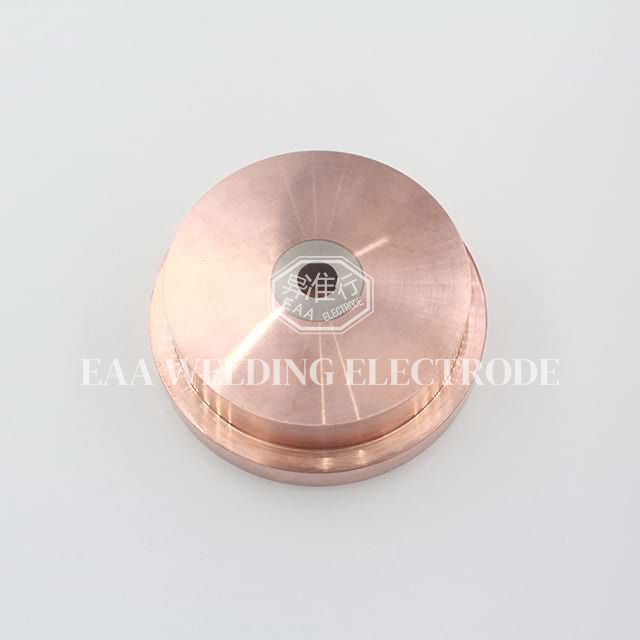
Flat / Backup Electrodes: Manufacturers use these massive flat copper blocks to prevent surface marring on Class A cosmetic welds. They also serve as the stable grounding base in projection welding applications.
Real-world manufacturing introduces complex variables that complicate standard selection processes. A reliable Resistance Welding Electrode setup must adapt to these physical challenges to maintain production quality.
Joining a thin sheet to a thick plate requires careful thermal balancing. Physics dictates that a molten nugget will naturally migrate toward the thicker, higher-resistance plate. If you use identical electrodes on both sides, the nugget may not penetrate the thin sheet at all, resulting in a failed joint.
To solve this, use an electrode with a larger contact face on the thicker material side. This intentionally decreases the current density on that side and accelerates heat dissipation. By cooling the thick side faster, you force the molten nugget back toward the joint interface, ensuring proper fusion between both sheets.
Galvanized steel poses a notoriously difficult challenge. During the weld, the zinc coating melts instantly. This liquid zinc seeks out the copper electrode and alloys with it, a process known as "pick-up." This creates a brittle brass alloy on the tip, causing sticking, rapid degradation, and severe pitting.
As a best practice, never use a brand-new, highly polished electrode directly on production galvanized parts. Instead, perform a "break-in" procedure. Run a dozen weld cycles on galvanized scrap metal first. This stabilizes the zinc coating effect on the new copper face. It conditions the tip and prevents the risk of cold welds on your actual production parts.
Even the most perfectly engineered electrode will fail rapidly if shop-floor implementation remains flawed. You must view these operational variables as serious implementation risks.
Operators frequently increase pneumatic descent speeds to shave milliseconds off cycle times. This high-speed impact smashes the soft copper tips against hard steel. This impact, rather than heat, causes the tip to flatten or "mushroom." As the face widens, the contact area increases, which drastically drops the current density. The result is a cold, weak weld. Remember, the machine is a welder, not a forming press. Control your descent velocity.
A dangerous myth persists on many shop floors. Many operators believe that heavy expulsion—sparks and spatter shooting across the room—indicates a strong, hot weld. In reality, expulsion is literally the violent vaporization of both your workpiece and your electrode face. Every time you throw fire, you destroy the tip life and weaken the surrounding metal. A perfect resistance weld should be silent and spark-free.
Thermal abuse kills copper alloys faster than any other factor. Internal water cooling tubes must extend deep into the cavity. They must reach to within 0.125 inches (approximately 3mm) of the electrode cavity bottom. If you cut the tube too short, steam pockets form, and cooling stops entirely. You must also maintain a continuous water flow of 0.5 to 1.5 gallons per minute.
Most standard holders use a friction taper fit. You must warn your technicians against over-pressurizing these taper fits during installation. Excessive force leads to severe galling, making the copper practically weld itself to the holder. To prevent this, apply a microscopic layer of conductive grease, such as castor oil, to the taper before insertion. This simple step vastly assists in future extraction without damaging the holder.
Sourcing these critical consumables requires more than just finding the lowest price online. You need shortlisting criteria to differentiate a premium partner from a basic commodity distributor.
When auditing a potential Resistance Welding Electrode manufacturer, demand strict material traceability and compliance. Ensure they rigorously adhere to RWMA and ISO 5182 material classifications. This guarantees that you receive consistent IACS conductivity percentages batch-over-batch. If a batch of Class 2 copper arrives under-hardened, your downtime will skyrocket.
Next, assess their advanced manufacturing capabilities. Look for a partner capable of producing custom refractory-faced composites. They should also demonstrate expertise in specialized geometries, like permanent insulated spacers used for parallel gap bonding. This shows they understand metallurgy beyond basic copper turning.
Finally, demand robust engineering support. A trustworthy manufacturing partner should assist you in comprehensive process audits. They should actively evaluate your weld schedules, analyze your applied force metrics, and troubleshoot your water cooling setups. They must act as process consultants rather than just catalog vendors selling raw consumables.
An optimized resistance welding operation relies heavily on a triad of core principles. You must achieve correct material matching, select cost-efficient geometries, and enforce disciplined process control regarding pressure, time, and cooling.
We encourage you to walk your shop floor today and conduct a rapid audit. Measure your scrap rates, track your tip dressing frequency, and observe your expulsion levels. If operators constantly fight sparks or mushroomed tips, your current setup is failing. Consult with a specialized manufacturer immediately to reassess and upgrade your current electrode specifications for better operational stability.
A: Primarily due to a combination of excessive heat and excessive mechanical impact. Inadequate water cooling softens the copper alloy. When combined with a high descent velocity from the pneumatic weld head, the impact flattens the soft tip. This widens the face and reduces current density.
A: Tungsten has a higher melting point but is brittle and prone to thermal shock cracking under rapid cycling. Molybdenum handles thermal cycling much better but oxidizes rapidly at lower temperatures. Selection depends on your specific heat generation needs and environmental controls.
A: Generally, no. Spot welding relies on the precise electrode face diameter to define the weld size. Projection welding relies on a physical dimple built directly into the workpiece. Therefore, projection welding usually requires flat, hardened copper plates or massive backup electrodes.
A: Optimize the weld schedule by using shorter, hotter welds. Ensure aggressive, deep water cooling to solidify the face quickly. Use appropriate dispersion-strengthened copper alloys, and dress the tips frequently to remove inevitable zinc build-up before it causes pitting.


