


Views: 0 Author: Site Editor Publish Time: 2026-09-23 Origin: Site


Resistance welding presents a unique engineering challenge. You must carefully balance high electrical conductivity against physical wear resistance to minimize machine downtime. Choosing the right electrode material is rarely a simple technical preference. It directly impacts your cost-per-weld, your tip dressing frequency, and overall joint consistency. When evaluating standard copper against advanced tungsten composites, engineers face conflicting priorities. High temperatures quickly destroy soft metals, yet hard metals inherently resist electrical flow. We aim to clarify this dilemma.
This article provides a clear, evidence-based evaluation framework. We will help production engineers and procurement teams determine exactly when the higher upfront cost of tungsten composites is justified. You will learn how specific material properties dictate performance on the factory floor, enabling you to optimize your welding operations effectively.
Standard copper electrodes (including alloys) offer superior conductivity but are prone to thermal fatigue and "mushrooming" in high-heat applications.
Tungsten copper composites resist sticking and deformation at extreme temperatures, making them critical for welding high-conductivity materials or automated runs.
A tungsten copper inlaid electrode offers a practical middle ground, combining the thermal mass of copper with the wear resistance of a tungsten facing.
Evaluating a tungsten copper electrode supplier requires verifying their powder metallurgy processes to ensure void-free, consistent material density.
Every resistance welding operation battles hidden costs. Frequent tip dressing forces production lines to stop. Electrode sticking damages delicate workpieces. Inconsistent current density produces rejected parts. These issues stem from a fundamental material conflict at the weld interface. A standard Copper Electrode carries current efficiently, but extreme heat degrades it over time.
To succeed, the ideal electrode material must meet two strict criteria. First, it must deliver sufficient current to the weld interface without excessive resistance. Second, it must not permanently deform under high pressure and intense heat. Engineers call this deformation "mushrooming." When an electrode mushrooms, its contact face flattens and widens. A wider face spreads the electrical current over a larger area. This drops the overall current density, resulting in cold, weak welds. Operators then increase the welding current to compensate, which only accelerates the melting and deformation cycle.
You must navigate the inevitable material trade-off. There is an inverse relationship between electrical conductivity and hardness at elevated temperatures. Highly conductive metals soften rapidly under heat. Hard, refractory metals resist heat perfectly but restrict electrical flow. Solving this production challenge requires matching the exact thermal profile of your workpiece to the specific metallurgical properties of your electrode.
Engineers typically start their material selection with standard copper. It provides excellent baseline metrics for both electrical and thermal conductivity. Pure copper sets the standard at 100% IACS (International Annealed Copper Standard). Because it dissipates heat rapidly, a basic copper spot welding electrode remains cool during fast, low-temperature weld cycles. However, pure copper softens at roughly 200°C. This makes it unsuitable for heavy industrial applications.
To solve this softening issue, metallurgists developed specialized alloys. The chromium zirconium copper electrode (CrZrCu) stands as the absolute industry standard. By adding small amounts of chromium and zirconium, manufacturers raise the material's softening temperature to nearly 500°C. They achieve this precipitation-hardened state without severely sacrificing conductivity, maintaining an impressive 80% IACS. This makes CrZrCu highly versatile for everyday manufacturing.
You will find these copper alloys work best when welding high-resistance materials like mild steel or stainless steel. In these applications, the electrical resistance of the steel itself generates the necessary welding heat. The electrode merely delivers the current and pulls away the excess heat. Since the heat concentrates inside the workpiece rather than at the electrode face, standard copper survives the cycle.
However, significant implementation risks arise when shifting away from standard steels. If you attempt to weld non-ferrous metals, galvanized steels, or battery tabs, standard copper fails quickly. Zinc coatings on galvanized steel melt and alloy directly with the copper tip. This creates brass on the electrode face, which sticks violently to the workpiece and causes rapid wear.
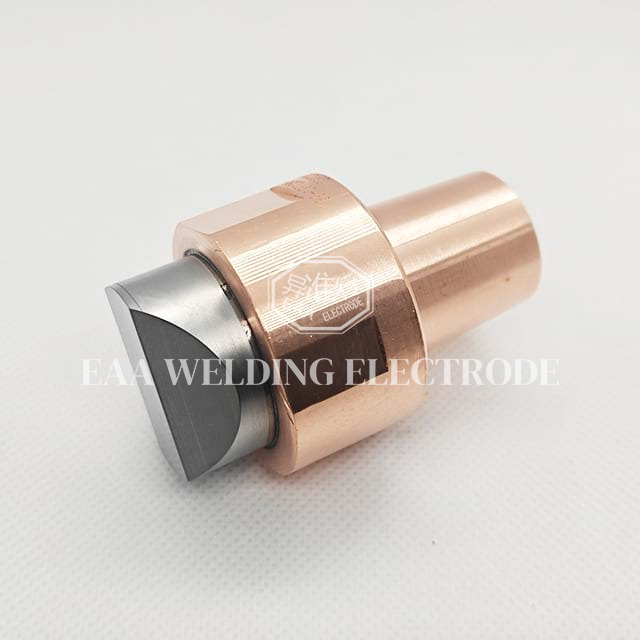
When baseline copper alloys fail, manufacturers turn to refractory composites. Tungsten copper is not a traditional alloy because tungsten and copper do not dissolve into one another. Instead, it is a pseudo-alloy or composite. Manufacturers use powder metallurgy to combine tungsten’s refractory high melting point (3422°C) with copper’s excellent conductivity. The resulting Tungsten Copper Electrode delivers unparalleled stability under extreme thermal stress.
The performance advantages of this composite are transformative for high-heat applications. Tungsten copper completely prevents electrode sticking. Because tungsten has no metallurgical affinity for materials like zinc, nickel, or pure copper workpieces, it refuses to micro-weld to the part. Furthermore, it offers superior arc erosion resistance. You can maintain precise tip geometry over thousands of weld cycles without stopping the machine for frequent dressing.
For many facilities, a solid tungsten copper tool is prohibitively expensive or lacks the necessary heat dissipation in the shank. We often recommend the inlaid alternative. An inlaid tool features a standard copper shank with a brazed tungsten-copper tip. This design provides a highly cost-effective method to achieve exceptional wear resistance exactly at the contact point. Meanwhile, the solid copper shank maintains rapid heat dissipation back into the water-cooling system.
You will find these refractory composites essential for specific use cases. They dominate cross-wire welding, where intense localized pressure would instantly crush a soft copper tip. They are also mandatory when spot welding highly conductive materials like copper or brass. Finally, high-volume automated battery pack manufacturing relies entirely on tungsten composites to weld nickel tabs without sticking.
Selecting the right tool requires a structured evaluation of material properties. You cannot simply guess which material will perform better. You must weigh conductivity against heat resistance based on your specific welding parameters.
Table 1: Material Performance Comparison
Material Type | Electrical Conductivity (% IACS) | Softening / Yield Temperature | Wear Resistance | Primary Application |
|---|---|---|---|---|
Pure Copper (Class 1) | ~95% - 100% | ~200°C | Low | Low-pressure aluminum/magnesium |
CrZrCu (Class 2) | ~80% | ~500°C | Medium | Mild steel, stainless steel |
Tungsten Copper (70W30Cu) | ~45% | Withstands >2000°C localized | Very High | Copper wire, brass, battery tabs |
The core of this evaluation relies on a simple concept known as the Golden Rule of Workpiece Compatibility. You must create a thermal imbalance in your favor. If you weld high-resistance materials (like steel), you must use highly conductive electrodes (like CrZrCu). The steel heats up, while the electrode stays cool. Conversely, if you weld highly conductive materials (like copper wire or aluminum buss bars), you must use resistive, refractory electrodes (like tungsten copper). The tungsten resists the current slightly, generating intense localized heat right at the tip to melt the conductive workpiece.
When conducting your cost-to-outcome analysis, avoid focusing solely on the initial purchase price. Standard copper requires lower initial procurement costs. However, you must factor in the extended lifespan and reduced maintenance downtime of tungsten copper. Reduced tip dressing means more machine uptime. Fewer rejected parts mean higher yield. When you eliminate sticking and automate the process, the overall operational efficiency easily justifies the composite material.
Consider these critical factors during your evaluation:
Downtime Costs: Track exactly how many minutes per shift operators spend dressing standard copper tips.
Scrap Rates: Measure the percentage of rejected parts caused by inconsistent current density.
Replacement Frequency: Calculate how many standard electrodes you consume compared to a single tungsten composite alternative.
The performance of any composite material depends entirely on how it is made. Manufacturing realities dictate that poorly manufactured tungsten copper will fail prematurely. Because tungsten and copper do not naturally mix, substandard manufacturing leaves microscopic voids (porosity) or uneven phase distribution. When current hits a void, it arcs internally. This creates dangerous hot spots, leading to rapid cracking and catastrophic failure during a weld cycle.
You must establish strict evaluation criteria when vetting your supply chain. Do not accept products based on price alone. You must demand specific technical validations from your chosen supplier to guarantee batch-to-batch reliability.
Here is what you should demand during the vetting process:
Verification of vacuum infiltration: Advanced powder metallurgy processes ensure the tungsten powder is pressed and sintered into a rigid skeleton. Liquid copper must then be drawn into the pores under a strict vacuum environment to eliminate all oxygen and voids.
Batch-to-batch consistency: Require material certifications proving the precise Tungsten-to-Copper (W/Cu) ratio remains consistent across every order. A variation in this ratio drastically alters both conductivity and hardness.
Precision machining capabilities: Refractory metals are notoriously difficult to machine. Your partner must demonstrate the capability to produce complex electrode geometries without causing micro-fractures in the finished product.
Standard copper alloys remain the reliable workhorse for traditional ferrous metals. They offer excellent conductivity and manage heat effectively for steels. However, tungsten copper represents the required standard for non-ferrous metals, high-volume automation, and specialized battery applications. By understanding the inverse relationship between conductivity and thermal hardness, you can eliminate sticking and reduce deformation.
We encourage production engineers to take immediate action on the factory floor. First, audit your current tip-dressing frequency to identify hidden downtime. Next, map out which welding stations handle non-ferrous or highly conductive workpieces. Finally, request material samples or detailed technical data sheets from certified suppliers. Running a controlled pilot longevity test will definitively prove how upgrading your electrode material streamlines your overall production process.
A: High localized heat causes standard copper to micro-weld directly to the nickel or copper battery tabs. This metallurgical bonding forces the machine to tear the electrode away, damaging the part. Tungsten copper mitigates this entirely due to its extremely high melting point and total lack of alloying affinity with the tab material.
A: No. CrZrCu is an age-hardened alloy that improves upon pure copper's wear resistance for general steel welding. However, it will still soften and deform rapidly at the extreme temperatures where a tungsten composite remains completely stable and hard.
A: The ratio defines the balance of properties. Higher tungsten content (e.g., 80W20Cu) significantly increases hardness, arc resistance, and heat tolerance, but it lowers overall conductivity. Higher copper content (e.g., 60W40Cu) improves electrical conductivity but sacrifices some wear resistance. You must match this ratio to your specific welding current and pressure requirements.


