


Views: 0 Author: Site Editor Publish Time: 2026-10-09 Origin: Site


Joining copper components presents a notoriously difficult bottleneck in modern manufacturing environments. Whether you are assembling EV battery tabs, electrical switchgear, or motor armatures, this highly conductive metal is constantly prone to high defect rates and process instability. Copper’s inherent physical properties actively resist the fundamental mechanics of resistance welding. It dissipates heat instantly and refuses to generate localized electrical resistance, making standard electrode materials both ineffective and exceptionally costly to maintain.
Achieving a stable, high-yield joining process requires operators to look beyond standard copper consumables. To succeed, manufacturers must shift toward engineered refractory metals designed specifically to manipulate thermal dynamics at the weld interface. In this comprehensive guide, we will explore exactly why copper behaves so stubbornly under welding conditions. You will discover how different refractory metals address these thermal challenges, allowing you to select the exact electrode architecture needed to eliminate downtime and secure reliable metallurgical bonds.
Copper’s high thermal and electrical conductivity prevents localized heat generation, requiring electrodes that can artificially create a heat imbalance.
Standard copper electrodes frequently weld themselves to the copper workpiece (alloying), causing severe production downtime for tip dressing.
A tungsten copper electrode provides the necessary balance of heat resistance and electrical conductivity for most copper-to-copper applications.
For applications requiring extreme high-temperature strength and wear resistance, a tungsten molybdenum electrode is the superior choice.
Choosing a tungsten inlaid resistance welding electrode optimizes both cost and cooling efficiency for high-volume automated lines.
Partnering with an experienced copper welding electrode supplier is critical to ensuring metallurgical bond integrity in composite electrodes.
To understand why copper resists conventional welding methods, we must examine the core physics of the process. Resistance welding relies entirely on the electrical resistance at the joint interface to generate heat. This relationship is defined by Joule's First Law, represented by the heat generation formula: $Q=I^2Rt$. In this equation, $Q$ stands for heat, $I$ represents the welding current, $R$ is the electrical resistance, and $t$ denotes time.
Because copper boasts virtually zero electrical resistance, it simply allows the current to flow straight through the material. It fails to generate sufficient heat ($Q$) at the contact point. Without adequate heat buildup, a proper weld nugget cannot form. You are effectively trying to heat a material designed specifically to carry electricity without friction.
Even when you manage to force heat generation through massive current spikes, a secondary physical barrier emerges: rapid thermal dissipation. Copper features exceptional thermal conductivity. It acts like an aggressive heat sink. It pulls heat away from the weld zone faster than the molten pool can stabilize and fuse. Before the nugget can solidify properly, the surrounding copper substrate absorbs the thermal energy.
This physical reality creates a severe business impact on the production floor. Manufacturers are forced to push exceptionally high welding currents through their machines just to combat the heat loss. Pushing equipment to its maximum capacity leads to excessive energy consumption and severe strain on welding transformers. Consequently, manufacturers experience highly inconsistent joint strength, leading to failed destructive tests and scrapped assemblies.
When operators attempt to weld copper substrates using standard Class 2 or Class 3 copper electrodes, they inevitably trigger a cascading failure known as the alloying effect. Under the intense heat and mechanical pressure required for the weld, the copper electrode and the copper workpiece react aggressively. Because they share the same melting point and chemical composition, their molecular structures fuse together.
The materials alloy at the contact surface, causing the electrode tip to physically weld itself to the workpiece. When the welding head retracts, it often tears the surface of the part or rips the electrode completely out of its holder. This sticking phenomenon ruins the component and halts production immediately.
Furthermore, standard electrodes suffer rapid mechanical deformation under these extreme parameters. Because copper requires such massive current loads, the electrode tips reach temperatures that severely compromise their structural integrity. The once-precise tip softens and flattens out under the clamping force. We refer to this plastic deformation as "mushrooming." Once a tip mushrooms, its contact surface area increases, which drops the current density even further, guaranteeing a failed weld.
The operational friction caused by these issues drains profitability. We can categorize these hidden costs through several common failure points:
Frequent Line Stoppages: Operators must pause automation continuously to manually file, dress, or replace stuck electrodes.
High Scrap Rates: Sticking electrodes tear the surface of expensive copper assemblies, resulting in immediate part rejection.
Consumable Burn-Rate: The rapid mushrooming effect forces plants to consume standard electrodes at an unsustainable pace, inflating maintenance budgets.
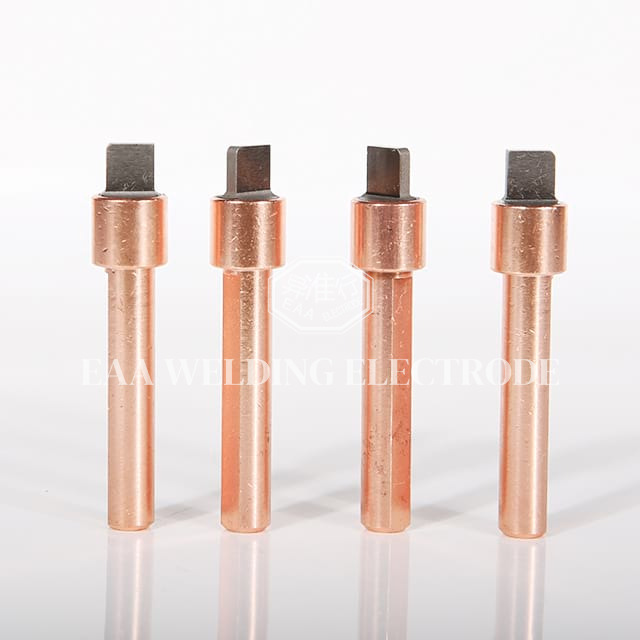
To overcome copper's lack of resistance and its aggressive heat dissipation, we must deploy a specific refractory metal strategy. You cannot use an electrode that shares the same properties as the workpiece. Instead, you need electrodes featuring significantly higher electrical resistance and far higher melting points than the copper substrate.
By using a highly resistive electrode tip, you artificially create a localized bottleneck for the electrical current. The electrode tip itself gets intensely hot, and it conducts that trapped heat directly into the copper joint. This thermal imbalance forces the copper to melt and form a nugget before the heat can escape.
A Tungsten Copper Electrode utilizes advanced powder metallurgy to combine two distinct elements. It merges the extreme high-temperature durability of tungsten with the excellent electrical conductivity of copper. The manufacturing process presses tungsten powder into a solid matrix and then infiltrates it with molten copper.
When evaluating this material, engineers find it ideal for general copper wire joining, braided wire compaction, and copper sheet welding. It delivers a perfect balance, generating enough tip heat to melt the workpiece while retaining enough conductivity to prevent the welding transformer from overloading. However, you must observe certain limitations. Under excessive thermal shock or inadequate water cooling, the tungsten matrix can suffer micro-cracking over time.
Alternatively, a Tungsten Molybdenum Electrode relies on the exceptional high-temperature yield strength of molybdenum. Unlike copper-infiltrated options, this alloy maintains rigid structural stability even when subjected to intense, prolonged heat.
This material outperforms others in harsh environments that require intense localized pressure. If you are performing micro-spot welding, joining coated copper surfaces, or welding dissimilar metals, molybdenum prevents electrode deformation completely. The primary trade-off involves its lower electrical conductivity. You must calibrate your welding machine precisely. If the current is pushed too high too fast, the extreme resistance of the molybdenum tip can cause surface burning on the workpiece.
Table 1: Technical Comparison of Refractory Electrode Materials
Evaluation Criteria | Tungsten Copper (W-Cu) | Tungsten Molybdenum (W-Mo) |
|---|---|---|
Primary Mechanism | Balanced thermal conductivity and resistance. | Maximum yield strength at high temperatures. |
Ideal Applications | Braided copper wire, standard copper sheets. | Micro-spot welding, high-pressure joints. |
Resistance to Deformation | High, but can micro-crack if poorly cooled. | Exceptional; maintains geometry under pressure. |
Machine Calibration Needs | Standard setup; forgiving to current spikes. | Requires precise control to avoid surface burns. |
While refractory metals perfectly solve the physics of welding copper, they introduce a secondary manufacturing challenge: material cost. Solid tungsten or molybdenum electrodes are prohibitively expensive for large-scale operations. Furthermore, machining solid refractory blocks into intricate electrode geometries is a slow, tool-destroying process.
To bridge this cost versus performance gap, industry leaders utilize an inlaid architecture. A tungsten inlaid resistance welding electrode offers the ultimate engineered solution. It consists of a highly conductive, easily machined copper shank equipped with internal water-cooling channels. At the very tip—the actual weld face—a precise disc of tungsten or molybdenum is securely brazed or back-cast into the copper.
This composite design places the expensive, heat-generating refractory metal exactly where it is needed, while the copper body handles bulk current transfer and rapid water cooling. However, procurement teams must watch out for implementation risks. Purchasing cheaply manufactured inlaid electrodes creates a dangerous "false economy."
If the brazed joint between the copper shank and the tungsten insert contains microscopic air voids, the tool will fail catastrophically. Voids act as thermal insulators. They block heat from transferring out of the tungsten tip and into the water-cooled copper shank. Consequently, the tungsten insert overheats instantly and shatters under the clamping pressure.
To prevent this, implement a strict verification strategy. Advise your procurement and engineering teams to demand Non-Destructive Testing (NDT) data, specifically ultrasonic scanning reports, from manufacturers. This data verifies a 100% void-free metallurgical bond between the inlay and the shank, ensuring maximum thermal transfer.
Transitioning to refractory materials requires more than simply ordering from a standard catalog. Your vendor selection criteria must prioritize long-term production stability, strict quality control, and technical expertise over the initial unit price.
First, evaluate their powder metallurgy expertise. The density and lifespan of composite materials dictate your line's uptime. Ensure the supplier owns and closely monitors the powder blending, pressing, and high-temperature sintering processes. Inconsistent powder density leads directly to uneven heat generation and rapid electrode degradation.
Next, assess their capabilities for custom machining and strict tolerances. Modern manufacturing relies heavily on automated and robotic welding cells. In these environments, dimensional consistency is non-negotiable. If an electrode tip is machined off-center by just a fraction of a millimeter, the robotic arm will strike the part at the wrong angle, destroying the assembly.
Finally, demand application engineering support. A credible copper welding electrode supplier will act as a technical partner. They should offer comprehensive process audits, analyzing your current production line to recommend specific welding schedules, clamping forces, and optimized water-cooling setups. They help you integrate the new metallurgy into your existing workflow smoothly.
Successfully welding copper components is rarely about upgrading your existing machine to deliver more brute-force power. Instead, it relies entirely on controlling the thermal dynamics exactly at the point of contact. Because copper aggressively dissipates heat and lacks electrical resistance, standard consumables will inevitably fail, stick, and deform.
Transitioning to engineered refractory materials represents a mandatory process upgrade. By implementing specialized metallurgical solutions, you artificially drive heat into the joint, completely eliminating the sticking dilemma. Taking advantage of inlaid architectures allows you to achieve this performance while maintaining efficient cooling profiles.
We encourage you to audit your current production floor today. Track how frequently operators pause to dress standard copper tips. Once you identify these hidden downtime metrics, consult with a specialized materials partner to run sample testing on refractory alternatives. Upgrading your consumable strategy is the fastest path to eliminating defect rates and achieving truly continuous production.
A: No. The materials will alloy and stick together due to identical melting points and conductivities, resulting in immediate electrode failure and part damage. They create a solid-state weld between the tool and the workpiece.
A: While highly dependent on the application, inlaid refractory electrodes typically outlast standard copper by 5x to 10x in copper-welding applications due to their resistance to mushrooming and sticking.
A: Yes. Because materials like tungsten generate significant heat at the tip, robust and continuous water cooling through the copper shank is mandatory to prevent the brazed joint from failing and the insert from cracking.
A: Select tungsten copper for a balanced current flow and heat generation in standard copper joints. Choose molybdenum when the process requires higher mechanical pressure at high temperatures without the tip deforming.


