


Views: 0 Author: Site Editor Publish Time: 2026-09-07 Origin: Site


Copper provides exceptional thermal and electrical conductivity. It maximizes battery efficiency but remains notoriously difficult to weld. Nickel welds easily but adds undesirable electrical resistance in high-drain applications. This dynamic creates an inherent metallurgical conflict.
The stakes are incredibly high for production engineers and battery pack designers. Inconsistent welds routinely lead to dangerous micro-arcing and severe localized heating. These defects eventually trigger catastrophic thermal runaway in dense battery packs.
Reliable tab welding at scale requires abandoning general-purpose consumables entirely. Manufacturers must adopt application-specific pulse configurations to control energy delivery. Success ultimately depends on deploying precision-engineered electrodes to master these complex thermal dynamics.
Copper-to-nickel welding requires overriding copper's heat dissipation properties through targeted energy delivery and correct electrode material selection.
Standard copper alloys degrade rapidly; an alumina dispersed copper electrode for batteries prevents tip sticking and maintains consistent weld nuggets.
Transitioning from prototype to production requires evaluating both equipment CapEx (Laser vs. Resistance) and ongoing consumable reliability (tooling life).
Partnering with a specialized custom battery welding electrode supplier mitigates supply chain risks and ensures batch-to-batch metallurgical consistency.
Joining dissimilar metals exposes distinct physical realities. Copper acts as an aggressive heat sink. It draws thermal energy away from the joint area rapidly. You need substantial energy to melt copper. However, this high energy often blows right through the thinner, more resistive nickel layer. You cannot treat both materials identically.
Manufacturers frequently encounter persistent bottlenecks during early production runs. These issues usually stem from a misunderstanding of interfacial resistance. We see three common failure modes repeatedly:
Electrode Sticking: This occurs due to localized overheating. The tab materials alloy directly into a subpar electrode tip. It ruins the consumable and halts production lines.
Weak Peel Strength: Energy fails to penetrate the copper layer sufficiently. You get a superficial surface bond instead of a proper weld nugget. It will fail under mechanical vibration.
Cell Damage: Excessive thermal transfer penetrates the battery casing. The heat damages the internal jelly roll or degrades safety seals. This creates immediate safety hazards.
Common Mistake: Operators often increase current blindly when facing weak peel strength. This amplifies electrode sticking and accelerates thermal damage.
The bottom line remains clear. You must define success criteria by repeatable peel strength. You need minimal thermal transfer. You also demand zero electrode sticking over thousands of cycles.
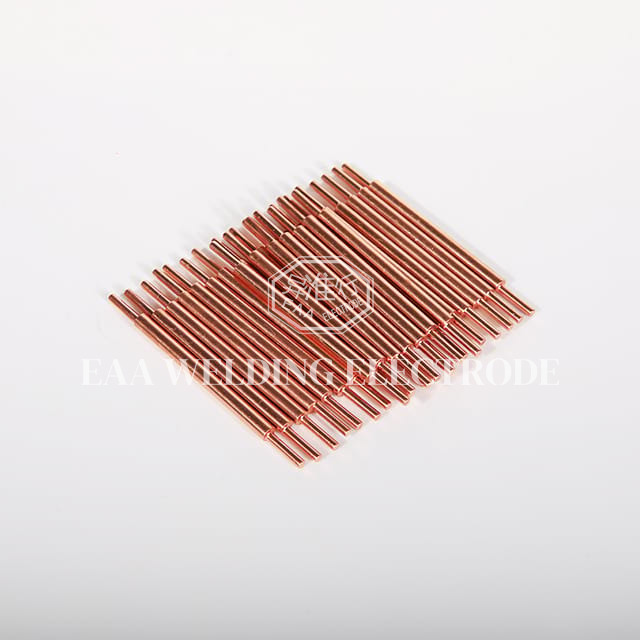
Tooling serves as the critical variable in your manufacturing setup. Upgrading your power supply will never fix bad welds if you specify the wrong Resistance Welding Electrode. The consumable dictates how energy enters the joint.
Electrode Material Decision Matrix
Material Type | Best Application | Pros | Cons |
|---|---|---|---|
RWMA Class 2 (Chromium Copper) | Standard nickel-to-nickel | Low initial cost, highly available | Softens quickly, mushrooms under high current |
Molybdenum & Tungsten Tips | Pure copper, extreme heat requirements | High heat resistance, excellent energy push | Prone to oxidation, can micro-crack easily |
Alumina Dispersed Copper (GlidCop) | Nickel-clad copper, standard copper tabs | Resists annealing, stops sticking entirely | Requires precision machining |
Let us examine these materials closer. RWMA Class 2 (Chromium Copper) handles standard nickel well. However, it softens and mushrooms rapidly when forced to handle the high currents needed for copper.
Molybdenum and tungsten tips offer massive heat resistance. They excel at pushing heat into the copper tab. Unfortunately, they remain prone to oxidation and micro-cracking if you neglect routine maintenance.
Alumina Dispersed Copper stands out as the industry standard. It retains hardness at elevated temperatures. It resists annealing completely. It eliminates sticking when you weld nickel-clad copper or pure copper.
Tip geometry also plays a massive role. You must select the right shape for your battery tab welding electrode. Domed tips concentrate energy in a small footprint. Flat tips distribute current widely but risk inconsistent contact. Truncated cone tips offer the best balance. They dictate optimal current density and guarantee deep weld penetration.
You cannot rely on material selection alone. Proper physical joint design and power delivery profiles determine final quality. Engineers rely on several proven methods to secure robust connections.
The "Sandwich" method represents a foundational technique. You place the resistive material (nickel) on top of the conductive material (copper). The nickel acts as a localized heating element directly under the Spot Welding Electrode. This traps the heat exactly where you need the nugget to form.
Slotted tabs offer another major advantage. Pre-slotted tabs force the electrical current path directly through the joint interface. Without a slot, current often shunts across the surface of the top tab. Shunting wastes energy and weakens the bond.
Pulse configurations transform difficult welds into repeatable processes. Dual-pulse welding is practically mandatory for dissimilar metals:
Pulse 1 (Cleaning): A low-energy pulse fires first. It burns off surface oxides and microscopic contaminants. It allows the electrodes to seat perfectly against the metal.
Pulse 2 (Welding): A high-energy, short-duration pulse follows immediately. It creates the actual weld nugget. The brevity prevents the copper from dissipating the heat prematurely.
Best Practice: Implementation carries specific risks. You must enforce strict pneumatic pressure control. Inconsistent air pressure alters contact resistance drastically. If your pressure fluctuates, your carefully tuned pulse settings become completely useless.
Scaling up to high-volume manufacturing forces a critical evaluation of core technologies. You must choose between advanced resistance welding and laser welding. Both paths offer distinct advantages and drawbacks.
Resistance Welding utilizes advanced consumables like a high-grade spot welding electrode.
Pros: It demands significantly lower CapEx. Operators understand the process well. It performs exceptionally for thick nickel and nickel-clad copper combinations.
Cons: The process requires frequent electrode dressing. You must replace consumables on a strict schedule.
Laser Welding utilizes concentrated light energy instead of physical contact.
Pros: The process is contactless. You experience absolutely zero electrode sticking. It remains highly repeatable for pure, thick copper applications.
Cons: It requires extreme CapEx. You face complex tooling and jigging requirements. Strict safety compliance is mandatory. The process is highly sensitive to reflective copper surfaces.
Looking through the evaluation lens, resistance welding remains the most viable ROI for most pack manufacturers. You can achieve massive scale efficiently. You only need to solve the consumable lifespan issue by integrating high-grade, advanced electrodes.
Supply chain dynamics dictate production floor uptime. Off-the-shelf electrodes fail rapidly in continuous automated production. They lack the metallurgical consistency required for copper-to-nickel joints. You must source partners who understand thermal constraints.
You need strict vetting criteria before approving a vendor:
Material Traceability: Can they prove the dispersion consistency in their alumina copper? Inconsistent alumina distribution causes premature tip failure.
Precision Machining: Physical tolerances matter immensely. A micro-variance in the electrode face changes the current density entirely. This inconsistency destroys your dual-pulse programming.
Custom Geometries: Battery pack designs grow tighter every year. Your supplier must show the ability to manufacture stepped or offset electrodes to navigate crowded cell matrices.
Take direct action for your next steps. Do not buy strictly on per-unit price. Request sample batches for lifecycle testing first. Measure the exact number of successful welds before tip dressing becomes necessary. Data-driven procurement ensures you select the right partner.
Reliable copper-to-nickel tab welding is not a dark art. It simply demands strict adherence to material science principles and active thermal management. You must respect the heat-sinking nature of copper.
The final verdict remains clear. The highest leverage point for improving weld quality is upgrading your tooling. You must match the electrode material to the extreme thermal demands of copper. Advanced composites solve sticking and extend uptime.
We encourage you to audit your current electrode lifespan immediately. Document your failure rates and downtime. Consult your supplier to test alumina dispersed or refractory metal electrodes on your lines.
A: Electrode sticking usually stems from excessive heat generation at the tip interface. High contact resistance, dirty tips, or incorrect pressure cause this heat spike. Using an electrode material with an annealing temperature that is too low also leads directly to alloying and sticking.
A: Generally, no. Pure copper requires significantly higher amperage than standard machines provide. It demands rapid energy delivery systems, like capacitive discharge or laser. You must combine this high energy with specialized tungsten or molybdenum electrodes to prevent heat dissipation.
A: Replacement schedules depend entirely on your material and current settings. Data-driven production environments track baseline peel strength daily. They schedule tip dressing right before degradation impacts acceptable tolerance limits. This often occurs every 1,000 to 3,000 welds for standard materials. Advanced composites last significantly longer.


