


Views: 0 Author: Site Editor Publish Time: 2026-06-15 Origin: Site


In high-volume manufacturing, you might assume the machine itself dictates production speed. However, the true bottleneck usually lies in the rapid degradation of consumable tooling. Subpar tools cause weak weld nuggets. They elevate scrap rates. They force excessive downtime for frequent redressing. You must treat the Spot Welding Electrode as a critical thermal-mechanical variable rather than a generic commodity. It dictates your overall cycle time. It ensures compliance to strict structural specifications. It determines your automation scalability. Upgrading this single component cascades into major production improvements.
In this guide, we explore the physical mechanics driving the welding cycle. We will map out high-stakes industry applications where precision matters most. You will learn how to match electrode materials to specific workpieces using established industry standards. Finally, we provide a structured framework to help you evaluate and select a reliable manufacturing partner for your consumable tooling needs.
Process Efficiency: Optimal electrode performance relies on balancing pressure, current, and time (Squeeze, Weld, Hold, Off) within a 10–100 millisecond window.
Application Specificity: Material mismatches cause rapid tool failure; selecting the right RWMA standard alloy is non-negotiable for handling modern materials like AHSS (Advanced High-Strength Steel) or conductive battery tabs.
Vendor Selection: A reliable spot welding electrode manufacturer provides metallurgical documentation, life-cycle testing data, and application-specific geometry consulting.
Understanding the physics behind resistance welding separates competent operators from true process experts. The operation relies fundamentally on Joule's Law, expressed as Q = I²Rt. In this equation, heat (Q) generates when a massive electrical current (I) meets resistance (R) over a specific time duration (t). The electrode must perform three contradictory tasks simultaneously. It conducts thousands of amps of current. It applies immense mechanical clamping force. It acts as a rapid heat sink to cool the newly formed weld.
To achieve a perfect joint, equipment controllers divide the process into a precise 4-stage cycle under heavy load. Every stage demands flawless performance from the consumable tip.
Squeeze Time: The electrode applies mechanical force to stabilize the metal sheets before any current flows. This pure mechanical pressure eliminates air gaps. It prevents explosive initial spatter when the circuit closes.
Weld Time (Upslope/Weld): Electrical current transfers through the metal. Dynamic resistance drops rapidly as the solid metal liquefies. The electrode tip must handle severe thermal shock, as local temperatures inside the joint easily reach 2000°C.
Hold Time: Current stops, but the electrode remains firmly clamped. It actively draws heat away from the molten pool. This rapid cooling forges the solid "button" or nugget between the sheets.
Off Time: The machine retracts the upper arm. The assembly repositions for the next cycle. The brief air exposure allows the tip to cool slightly.
Modern production introduces advanced considerations. Massive electrical currents generate strong magnetic fields. These fields physically drive molten metal outward at high speeds, risking internal voids. Furthermore, surface oxides create high initial contact resistance. Controllers often use dual-pulse schedules to overcome this barrier. A brief initial pulse softens the metal. A pause allows the tip to seat deeper. Finally, the main pulse executes the weld. This dynamic environment explains why maintaining pristine tip geometry remains absolutely vital for consistency.
Basic mild steel joining represents only a fraction of modern industrial demands. Specialized sectors push consumable tooling to extreme limits. In these environments, material science dictates success or failure.
A standard passenger vehicle chassis relies on 1,500 to 2,000 individual spot welds for structural integrity. Modern automakers heavily utilize Advanced High-Strength Steel (AHSS) to reduce weight while improving crash safety. AHSS introduces severe processing challenges. It requires extremely short weld durations, typically under one-fifth of a second. Prolonged heat application alters the steel's metallurgical grain. This creates a brittle joint prone to catastrophic failure during a collision. Specialized tips must deliver massive energy instantly and extract heat just as fast.
Electric vehicle manufacturing demands absolute precision. Battery modules require welding highly conductive nickel strips directly to steel battery cans. These metal gauges often measure between 0.1mm and 0.3mm in thickness. The thermal impact zone must remain virtually zero. Any excess heat penetration could puncture the battery casing or degrade the volatile internal chemicals. This micro-joining process relies on specialized tip profiles and inverted power supplies to maintain pinpoint energy control.
Aerospace engineers rely on resistance welding to assemble lightweight titanium honeycomb structures for aircraft wings. The medical sector uses similar techniques to seal titanium pacemaker casings. Titanium reacts aggressively to oxygen at high temperatures. Electrodes used in these fields often feature refractory metals to prevent sticking and contamination. The process leaves zero room for error, as human lives depend directly on joint integrity.
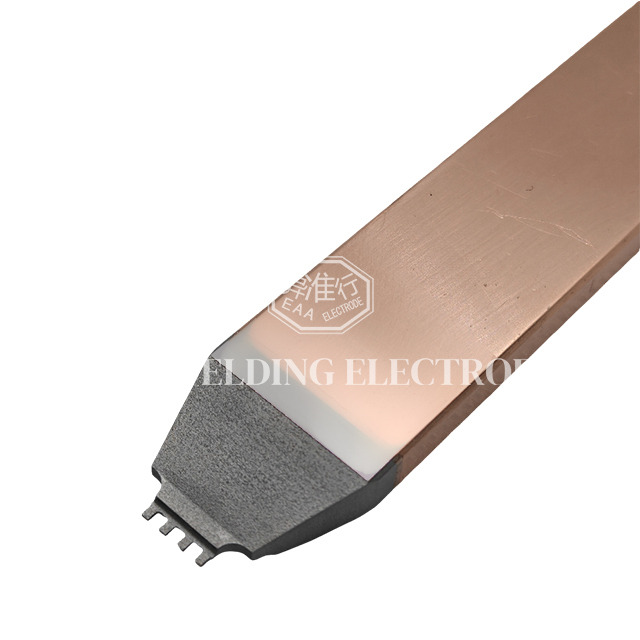
Shifting your focus from the welding machine to the consumable itself unlocks significant operational advantages. Getting the material choice right mitigates risk and drives measurable production efficiency.
Low-grade copper alloys deform quickly under repeated mechanical pounding and thermal cycling. Engineers call this deformation "mushrooming." As the tip face flattens and widens, current density drops. This leads to weak, undersized nuggets. High-quality alloys resist this deformation. They maintain their specified face diameter far longer. This extends the operational intervals between tip redressing and complete replacement, keeping robotic lines running smoothly.
Proper tip diameter and optimal material hardness directly prevent surface damage. Industry standards mandate that surface indentations remain below a strict 25% sheet thickness tolerance. Excessive indentation weakens the surrounding metal. It also creates aesthetic defects requiring costly rework. A correctly specified tip distributes pressure evenly, containing the molten core and eliminating expelled spatter.
Robotic welding cells execute hundreds of cycles per minute. In these dense arrays, consistent electrical conductivity proves essential. If a tip degrades, resistance increases. Current always seeks the path of least resistance. It may travel through a previously completed adjacent weld rather than the current joint. We call this the "shunting effect." Premium tooling ensures consistent resistance values at the tip interface. This guarantees every automated cycle hits the required structural strength threshold.
Clean joints drastically reduce downstream labor. A highly conductive tip narrows the Heat Affected Zone (HAZ). It prevents surface burning and heavy discoloration. Consequently, your production line eliminates mandatory post-weld grinding, sanding, or chemical cleaning stages. Parts move directly from the welding cell to assembly or painting.
Procurement teams must abandon the idea of a universal consumable. You must match the tool metallurgy directly to your specific substrate. The fundamental rule states that the electrode must possess significantly lower electrical resistance than the workpiece itself. If the tool resists current more than the sheet metal, heat generates inside the tool, melting it instantly.
The Resistance Welding Manufacturing Alliance (RWMA) categorizes alloys to simplify this decision logic. Adhering to these standards ensures predictable results across various metals.
For High-Resistance Metals (Mild Steel, Stainless Steel): These materials generate heat easily. You require high-conductivity copper alloys. RWMA Class 2 (Chromium Copper) serves as the industry standard. However, stainless steel presents high mechanical hardness. It requires elevated clamping pressure to forge the nugget, meaning the Class 2 alloy must be properly cold-worked to resist physical deformation.
For Coated Metals (Galvanized Steel): The automotive industry relies heavily on zinc-coated steel for rust prevention. Zinc melts at a much lower temperature than the steel substrate. It quickly forms an alloy with standard copper tips. This degrades conductivity and causes severe sticking. You must specify dispersion-strengthened copper (like RWMA Class 20) or employ specific pulsing schedules to boil away the zinc before forging the steel.
For High-Conductivity Metals (Copper, Gold, Aluminum): Welding conductive metals presents a paradox. They resist heating. Therefore, you must use highly resistive, refractory metal electrodes like Tungsten or Molybdenum (RWMA Class 11 or 13). These tools intentionally heat up. They force heat generation at the joint interface rather than waiting for the conductive workpiece to heat itself.
Material composition covers only half the equation. Physical shape dictates energy concentration. Pointed tips suit micro-electronics. Domed tips offer excellent alignment forgiveness in manual operations. Flat, truncated cones provide maximum pressure distribution for high-strength steels. As a general industry rule, standard processes face a maximum penetration limit of approximately 3mm per sheet. Thicker materials demand specialized projection welding techniques rather than simple spot joining.
Electrode Material Decision Matrix | ||
Workpiece Material | Recommended RWMA Class | Primary Technical Challenge |
|---|---|---|
Clean Mild Steel | Class 2 (Chromium Copper) | General wear and mushrooming over time. |
Stainless Steel | Class 2 or Class 3 | High mechanical hardness requires superior tip strength. |
Galvanized Steel | Class 20 (Dispersion Strengthened) | Zinc alloying causes severe tip sticking and degradation. |
Aluminum / Brass | Class 1 or Class 2 | High thermal conductivity requires massive instant current. |
Copper Wire / Tabs | Class 11 or Class 13 (Tungsten/Moly) | Substrate refuses to heat; tool must generate interfacial heat. |
Once your engineering team defines the required parameters, the focus shifts to vendor vetting. Evaluating a Spot Welding Electrode manufacturer requires diligence. A superficial purchasing decision jeopardizes millions of dollars in automated equipment uptime.
First, verify metallurgical consistency. Ask vendors to provide verifiable material data sheets. These documents must prove strict adherence to RWMA alloy chemistry and hardness standards. Minor impurities in copper alloys drastically reduce electrical conductivity and mechanical lifespan.
Second, demand application-specific engineering support. A credible supplier does not simply email a catalog. They ask detailed questions about your process. They evaluate your squeeze, weld, and hold times. They analyze your power supply type, noting the vast differences between AC transformers and modern Medium Frequency Direct Current (MFDC) inverters. They use this data to quote a consumable tailored exactly to your thermal limits.
Finally, assess supply chain reliability. The financial penalty of halting an automotive assembly line dramatically outweighs the unit price of consumable tooling. You must evaluate the vendor's inventory depth and global lead times. Request quality control documentation, including historic nugget size data and peel test records from previous production runs. A reliable partner acts as an extension of your own quality assurance department.
The consumable tip serves as the critical nexus of electrical efficiency, mechanical pressure, and thermal management. Treating it as an afterthought guarantees production bottlenecks, inconsistent joint strength, and excessive scrap rates. By applying rigorous metallurgical logic to your selection process, you safeguard your automated cells against premature failure.
To optimize your current assembly line, take the following action steps:
Audit your existing redressing intervals and measure the precise rate of tip mushrooming across different shifts.
Track your current scrap rates directly linked to surface indentation or failed peel tests.
Consult with a specialized Spot Welding Electrode engineer to map your specific substrates to the ideal RWMA classification.
Implement a trial run using premium alloys to measure the exact increase in continuous automated cycles.
A: Standard processes handle sheet thicknesses under 3mm. Thicker materials require larger electrode face diameters to distribute pressure and higher current to achieve fusion. If you use an undersized tip on thick metal, it concentrates excessive heat, causing deep surface indentations and heavy spatter without penetrating the core.
A: The protective zinc coating melts at a much lower temperature than the underlying steel. This liquid zinc instantly alloys with the heated copper electrode tip, forming brass. This degrades conductivity and physically welds the tool to the workpiece. Specialized alloys and precise pulse scheduling prevent this build-up.
A: Lifespan varies dramatically based on the application. You might achieve only a few thousand welds on heavily galvanized steel before requiring redressing. Conversely, a premium alloy tip can execute tens of thousands of cycles on clean mild steel. Upgrading your material class drastically extends this operational lifecycle.


