


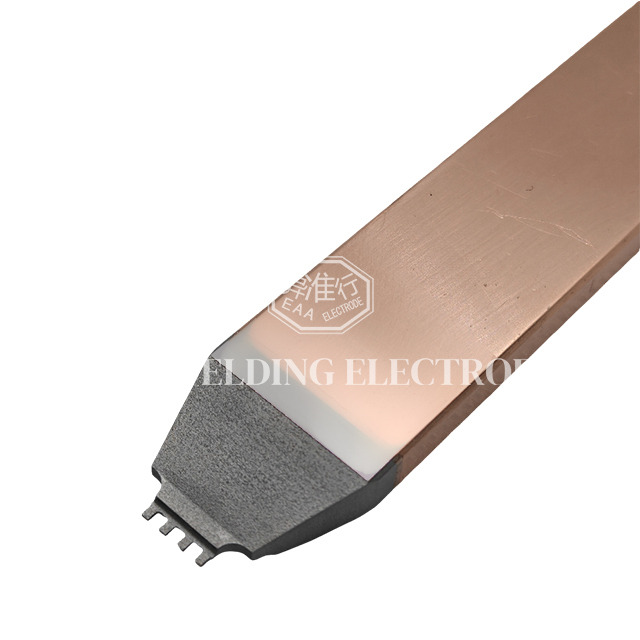


The ultra-thin head slotted tungsten copper inlaid electrode is designed for precision resistance welding applications that require stable current output, accurate contact positioning, and reliable lap welding performance. By combining a chromium zirconium copper body with a pure molybdenum inlay, this electrode provides both excellent electrical conductivity and enhanced wear resistance during repeated welding cycles.
Its ultra-thin head structure helps reduce unnecessary heat loss, while the slotted inlay design supports controlled current distribution and balanced welding pressure. This makes it suitable for automated welding equipment, small-component welding, sheet metal joining, terminal welding, and applications where consistent weld quality is required.
Technical Parameters
Item | Specification |
Material | Chromium zirconium copper + pure molybdenum |
Structure | Thin head with slotted inlay |
Dimensions | 80*17*5mm |
Tolerance | Based on drawings or national standards |
Manufacturing Process | Machining + welding |
Surface Finish | Machined surface |
Inlay Type | Molybdenum insert |
Application Method | Lap welding |
Heat Resistance | Stable under continuous welding cycles |
Customization | Size, slot width, and inlay type |
Specifications can be adjusted according to welding equipment and application needs.
Product Features
The chromium zirconium copper base offers excellent conductivity and thermal performance, helping the electrode transfer current efficiently during resistance welding. The pure molybdenum inlay improves resistance to heat, deformation, and surface wear, making the electrode more suitable for continuous production environments.
This material combination helps maintain stable electrical output and reduces performance fluctuation during repeated welding cycles.
The ultra-thin head design allows the electrode to reach narrow or limited welding areas more easily. It provides accurate contact with the workpiece and helps concentrate welding energy at the required position.
This structure is especially suitable for small components, thin sheets, terminals, connectors, and welding tasks that require controlled pressure and precise positioning.
The slotted structure helps guide the current path and improve pressure distribution during welding. By optimizing the contact area, it supports more consistent heat input and helps improve weld stability.
The slot width, depth, and position can be customized according to welding fixtures, product structure, and application requirements.
The electrode is produced through precision machining and welding. This helps ensure dimensional stability, clean surface quality, and reliable inlay bonding.
Consistent machining accuracy allows the electrode to fit automated welding systems and customized fixtures more effectively.
EAA supports customization based on customer drawings, welding equipment, and production requirements. Available customization options include overall size, head thickness, slot design, inlay material, surface finish, and tolerance control.
Engineering support is also available for electrode selection, welding parameter suggestions, and application evaluation.
Applications
This ultra-thin head slotted tungsten copper inlaid electrode is suitable for a wide range of resistance welding applications, including:
Lap welding of stainless steel sheets
Carbon steel sheet welding
Galvanized and coated material welding
Terminal and connector welding
Electronic component assembly
Small precision parts welding
Multi-layer sheet welding
Automated resistance welding production lines
Welding applications requiring stable contact geometry
EAA Welding Process
The copper alloy body provides efficient current conduction, while the molybdenum inlay helps maintain stable contact performance under heat and pressure.
The molybdenum insert improves the durability of the working surface, making the electrode more suitable for repetitive welding operations.
The thin head and slotted structure help control heat concentration, reducing unnecessary thermal deviation across the weld area.
Precision machining supports stable installation, accurate positioning, and repeatable welding results.
The electrode can be customized to match automated fixtures and welding systems, supporting consistent performance in continuous production.
Customization Services
EAA provides customized electrode manufacturing according to customer drawings and welding requirements.
Overall length, width, thickness, and head structure can be adjusted according to equipment and fixture requirements.
Slot width, depth, length, and position can be modified to optimize current distribution and welding pressure.
Different inlay shapes and materials can be selected according to the welded material, welding frequency, and required service life.
EAA can provide support for electrode selection, welding application analysis, parameter suggestions, and troubleshooting.
Each electrode is manufactured through controlled machining and welding processes. The product is designed to meet customized drawing requirements and maintain stable dimensional accuracy.
The machined surface, welded inlay, and thin-head structure are inspected to support reliable performance during resistance welding operations.
Selecting the right manufacturing partner is as critical as selecting the right component for your machinery. We bring decades of metallurgical expertise and precision engineering to the table, ensuring that every electrode delivered exceeds rigorous industry expectations. Our commitment to quality control is uncompromising, with every unit subjected to thorough inspection before it leaves our facility.
Unmatched expertise in advanced composite metal bonding and high-tolerance CNC machining.
A relentless focus on solving complex thermal and electrical conductivity challenges for modern assembly lines.
Proactive customer service that acts as a dedicated extension of your own engineering and procurement teams.
Continuous investment in cutting-edge manufacturing technology to maintain and elevate strict quality standards.
A proven track record of elevating production efficiency and reducing operational overhead for demanding global clients.
Frequently Asked Questions (FAQ)
The slotted design helps guide current flow and distribute welding pressure more evenly. It supports stable heat input and improves welding consistency.
Molybdenum offers excellent heat resistance, wear resistance, and pressure resistance. It helps improve electrode durability during repeated welding cycles.
Yes. The electrode can be customized according to customer drawings, including overall size, slot width, slot depth, head thickness, and inlay structure.
It can be used for stainless steel, carbon steel, galvanized steel, coated sheets, brass, and mixed-material sheet structures, depending on the welding process and equipment settings.
Yes. Its precision-machined structure and customizable design make it suitable for automated resistance welding systems and dedicated welding fixtures.
Keep the welding surface clean, avoid excessive mechanical impact during installation, and check the working face regularly to maintain stable welding quality.


