


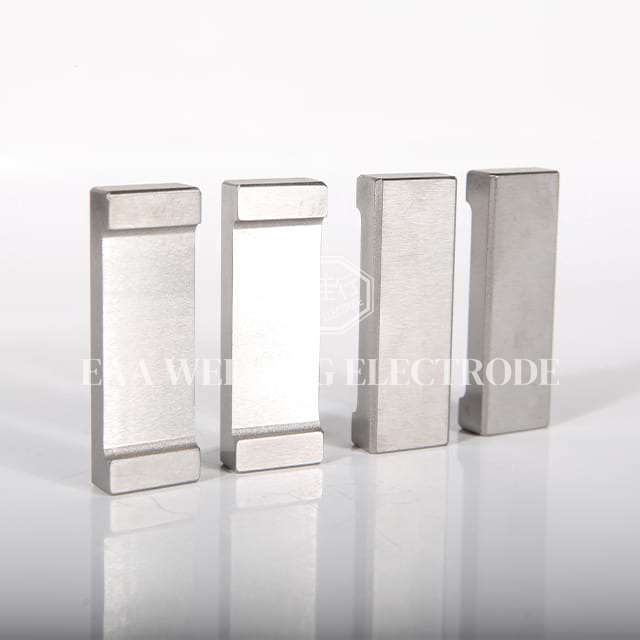


The saddle shaped pure tungsten electrode is designed for precision resistance welding applications that require stable positioning, concentrated current output, and reliable pressure distribution. Made from pure tungsten and manufactured by precision machining, this electrode provides excellent heat resistance, wear resistance, and dimensional stability during repeated welding cycles.
Its saddle-shaped contact surface helps improve alignment on curved, flat, or slightly irregular workpieces. This structure reduces slipping during lap welding and supports consistent welding quality in both manual fixture welding and automated production systems.
Technical Parameters
Item | Specification |
Material | Pure Tungsten |
Shape | Saddle-shaped |
Dimensions | 40 × 10 × 6 mm |
Tolerance | Per customer drawings or national standards |
Manufacturing Process | Machining |
Surface Finish | Machined finish |
Electrode Structure | Uniform arc surface |
Application Method | Lap welding |
Heat Resistance | Stable under continuous current |
Customization | Size, shape, tolerance available |
All specifications can be customized based on equipment and process requirements.
Product Features
Pure tungsten offers excellent high-temperature stability and strong resistance to deformation under repeated current and pressure. This makes the electrode suitable for demanding resistance welding processes where the working surface must remain stable during continuous production.
Compared with conventional copper-based electrodes, pure tungsten provides better resistance to wear and thermal impact in applications that require a durable contact surface.
The saddle-shaped contact surface improves electrode positioning during lap welding. Its curved geometry helps the electrode match the workpiece more securely, reducing the risk of sliding, offset contact, or uneven pressure.
This design is especially useful when welding small parts, curved components, narrow contact areas, or workpieces that require accurate electrode alignment.
The arc-shaped working surface helps distribute welding force more evenly across the contact area. Better pressure distribution supports more consistent heat input, helping improve weld stability and reduce variation between welding cycles.
This is important for applications where repeatability and stable joint quality are required.
The electrode is produced through mechanical machining to ensure accurate dimensions, clean edges, and a stable contact surface. Precision machining allows the electrode to fit customized fixtures and welding equipment more effectively.
The 40 × 10 × 6 mm structure can also be adjusted according to customer drawings and actual welding conditions.
The saddle shape, curvature, thickness, and overall geometry can be customized according to the welding fixture, workpiece structure, and required contact area. This allows the electrode to meet different welding process requirements in industrial production.
Applications
This saddle shaped pure tungsten electrode is suitable for various resistance welding applications, including:
Lap welding of thin metal sheets
Stainless steel component welding
Carbon steel part welding
Plated material welding
Small metal assembly welding
Electrical component welding
Precision fixture welding
Automated resistance welding lines
Welding operations requiring stable electrode positioning
Applications involving curved or special-shaped workpieces
EAA Welding Process
Pure tungsten helps maintain stable current transmission during welding. The machined contact surface supports consistent contact with the workpiece, reducing current fluctuation caused by poor alignment.
Tungsten has strong high-temperature resistance, making it suitable for welding processes with repeated heating and cooling cycles.
The pure tungsten working surface offers good wear resistance, helping extend service life under suitable welding parameters and maintenance conditions.
The saddle-shaped structure helps the electrode remain centered during welding, improving contact accuracy and supporting stable weld formation.
With customized dimensions and controlled machining accuracy, the electrode can be used in automated welding equipment and dedicated welding fixtures.
Customization Services
EAA provides customized electrode manufacturing according to customer drawings, samples, and welding requirements.
Length, width, thickness, and contact area can be adjusted to match the welding machine and fixture design.
The saddle angle, arc radius, and contact length can be redesigned according to the shape of the welded workpiece.
Tolerance can be controlled according to customer drawings or applicable production standards.
Different surface finish requirements can be supported depending on welding accuracy, contact resistance, and fixture requirements.
EAA can provide electrode selection advice, structure optimization, and welding process suggestions based on the customer’s actual welding application.
Each saddle shaped pure tungsten electrode is manufactured through controlled machining processes. Key dimensions, contact surface geometry, and surface quality are checked to ensure stable installation and reliable welding performance.
The electrode is designed to meet customized drawing requirements and support repeatable welding results in production environments.
EAA specializes in customized precision electrodes for resistance welding applications. With experience in tungsten electrodes, tungsten copper electrodes, copper alloy electrodes, and special-shaped resistance welding electrodes, EAA provides electrode solutions for customers in metal processing, electronics, automotive parts, and industrial manufacturing.
EAA supports drawing-based production, customized structure design, material selection, machining, and application guidance to help customers improve welding stability and production efficiency.
Frequently Asked Questions (FAQ)
1. What benefits does the saddle shape provide in welding?
It stabilizes electrode contact and distributes force more evenly in lap welding.
2. How long is the service life of this electrode?
Service life depends on welding load, but pure tungsten maintains stability over long production cycles.
3. Can the curvature of the saddle surface be customized?
Yes, all geometric parameters can be modified according to drawings.
4. How should I maintain the electrode surface?
Keep the contact area clean and avoid excessive force during installation.
5. What types of metal can be welded with this electrode?
It works well with stainless steel, carbon steel, plated materials, copper alloys, and composite metals.


