


Views: 0 Author: Site Editor Publish Time: 2026-09-01 Origin: Site


A resistance welding electrode functions as far more than a simple consumable item. It serves as a critical tooling component. It directly dictates thermal dynamics, electrical conductivity, and precise applied force during manufacturing. Modern assembly lines rely on these components to forge millions of flawless connections daily.
Suboptimal electrode selection triggers severe manufacturing bottlenecks. It routinely escalates tip dressing frequency. It drives up scrap rates and forces unexpected line downtime. When you mismatch your tooling to your base material, you lose critical process stability. Poor choices bleed operational budgets and delay production targets.
We will decode the essential material, geometric, and process variables required for high-volume manufacturing. You will learn how to align thermal management with specific metallurgical traits. Ultimately, this guide provides the exact criteria needed to specify the correct electrode for consistent, defect-free production runs.
Material dictates lifespan: Balancing electrical conductivity and metallurgical hardness (RWMA classifications) is the baseline for electrode selection.
Geometry controls density: The electrode face profile must match the required current density and physical constraints of the workpiece.
Cooling is non-negotiable: Inadequate thermal management accelerates electrode degradation (mushrooming/alloying), overriding all other optimized variables.
Modern steels require specific tooling: Advanced High-Strength Steels (AHSS) and galvanized coatings demand stricter control over electrode force and material composition.
Improper electrode specification creates cascading operational costs. Many engineering teams view Resistance Welding Electrodes as basic commodities. This assumption inevitably leads to frequent machine stoppages for tip replacement. It also causes inconsistent nugget formation across shifts. You will likely experience failed destructive testing when parameters drift out of specification. Every minute spent changing a stuck cap represents lost manufacturing capacity.
You must establish strict success criteria for electrode selection. A truly optimized process delivers highly repeatable results. Consider the following baseline targets for your production lines:
Consistent weld nugget diameter across the entire production run.
Maximized operational time between required tip dressing cycles.
Total elimination of sticking or localized melting at the electrode-sheet interface.
Evaluating your tooling based on initial unit price is fundamentally flawed. A cheaper cap often demands double the maintenance intervention. You must evaluate the Cost Per Weld (CPW) instead. CPW accounts for cap longevity, scrap reduction, and avoided downtime. When you prioritize continuous uptime over unit price, overall production efficiency dramatically improves.
You must balance electrical conductivity against metallurgical hardness. The Resistance Welding Manufacturing Alliance (RWMA) categorizes materials to standardize this balance. Selecting the right alloy prevents premature wear and ensures proper heat generation at the weld interface.
The core industry-standard material classifications provide distinct advantages for specific base metals.
RWMA Class 1 (Copper-Cadmium/Copper-Zirconium): These alloys deliver high electrical and thermal conductivity but feature lower mechanical hardness. They excel at welding aluminum alloys. They also perform exceptionally well on galvanized and coated materials.
RWMA Class 2 (Copper-Chromium/Copper-Chromium-Zirconium): Manufacturers consider this the industry workhorse. It offers a highly balanced ratio of conductivity to hardness. It serves as the optimal choice for cold-rolled and standard automotive steels.
RWMA Class 3 (Copper-Nickel-Silicon/Copper-Beryllium): This classification provides very high mechanical strength but lower electrical conductivity. You need this extreme hardness for high-resistance materials like stainless steel and Inconel.
RWMA Electrode Material Comparison
RWMA Class | Alloy Composition | Primary Characteristic | Best Suited For |
|---|---|---|---|
Class 1 | Copper-Zirconium | High Conductivity | Aluminum, Galvanized Steel |
Class 2 | Copper-Chromium | Balanced Traits | Mild Steel, Cold-Rolled Steel |
Class 3 | Copper-Nickel-Beryllium | High Hardness | Stainless Steel, Inconel |
Your selection logic must follow a simple inverse mapping rule. High-resistance workpieces require low-resistance (high-conductivity) electrodes. Conversely, highly conductive workpieces like aluminum require highly conductive electrodes alongside massive current bursts. Matching the electrical resistance of the workpiece to the inverse properties of the electrode prevents interface melting. It forces the heat generation precisely between the two metal sheets where the nugget must form.
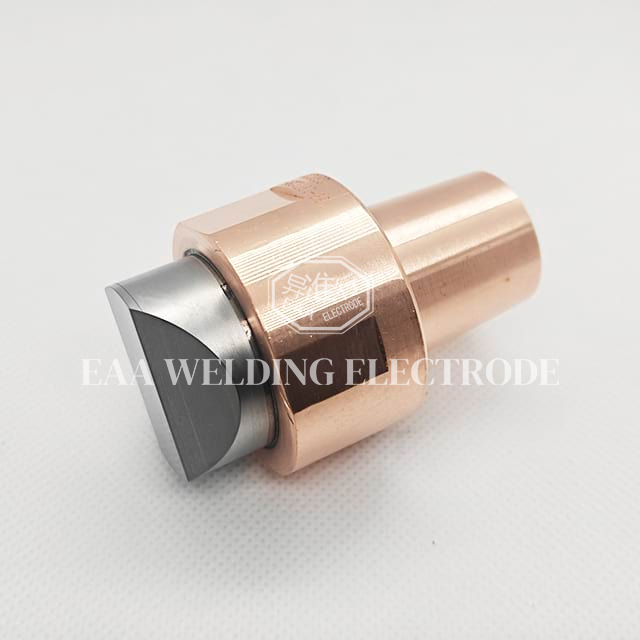
Shape dictates weld quality. The physical profile of the electrode face controls how electrical current concentrates into the metal. If you misjudge the geometry, you risk blowing holes in the material or failing to generate enough heat for fusion. You must map specific features to your desired manufacturing outcomes.
We evaluate geometry across three primary face profiles:
Pointed/Truncated Cone: This shape provides highly concentrated current density. It forces the heat into a very tight area. However, it risks rapid wear and severe mushrooming under high mechanical force.
Dome/Radius: The dome profile offers excellent alignment tolerance. It naturally accommodates slight angular deviations in the welding gun. It wears gradually and evenly. Manufacturers establish this as the gold standard for high-volume robotic spot welding.
Flat: Flat faces minimize surface indentation. You typically use them for visible cosmetic surfaces. They also function well as backing electrodes. They require extremely strict alignment, as any tilt concentrates current onto a single sharp edge.
You must actively monitor the "mushrooming" risk. Continuous thermal cycling and repetitive mechanical slamming expand the copper face diameter over time. As the face widens, the contact area increases. This expansion drops the current density dramatically. When the density falls below a critical threshold, the nugget simply fails to form. We call this a "cold weld." Proper dressing schedules combat this geometric deformation.
Even the perfect alloy and geometry will fail without process control. Thermal management acts as the true backbone of Resistance Welding Electrodes longevity. Internal water cooling tubes extract destructive heat away from the copper face.
A major implementation risk involves inadequate water flow. Insufficient flow rates or improper water tube depth trap boiling water near the tip. This heat buildup causes rapid tip annealing. The copper softens, mushrooms instantly, and fails catastrophically. The water tube must reach exactly to the specified depth inside the cap cavity. Cutting the tube too short destroys the cooling dynamic.
Electrode force requires an equally delicate balance. You must apply enough pressure to contain the molten metal nugget. If pressure drops too low, molten steel explodes outward as expulsion. If you apply excessive pressure, you mechanically crush the heated copper face. Excessive force accelerates wear and damages the component.
You must align all electrode variables against your specific weld schedule. The weld controller dictates squeeze, weld, hold, and off times. A hard Class 3 electrode might survive a long hold time, while a Class 1 might deform. You must test your selected tooling against the precise current bursts and physical timing of the robotic controller.
Modern vehicle architectures and advanced appliances utilize complex materials. These metals present unique hurdles for traditional spot welding parameters. You must adapt your tooling strategies to accommodate these modern metallurgical challenges.
Galvanized steels heavily rely on zinc coatings to prevent rust. The challenge arises because zinc melts at a significantly lower temperature than steel. The molten zinc alloys directly with the copper electrode. This reaction creates a brass layer on the electrode face. Brass possesses high electrical resistance. It causes immediate sticking, sparking, and severe pitting on the copper surface.
The solution requires optimized material and process adjustments. You should specify Class 1 or Class 20 dispersion-strengthened copper. You must also implement optimized stepper programs. A stepper gradually increases the welding current over hundreds of cycles. This extra current punches through the accumulating brass layer, maintaining consistent heat generation despite the contamination.
Advanced High-Strength Steels (AHSS) introduce a completely different challenge. AHSS materials exhibit incredible yield strength. To force two panels together without gaps, the robotic gun must apply massive mechanical force. This high pressure inflicts severe mechanical wear on standard Class 2 caps.
The solution involves evaluating tighter face geometries. You must also enforce stricter tip-dressing schedules. Frequent, light dressing removes minor deformations before they escalate into structural failure. Upgrading to slightly harder alloys can sometimes help, but rigorous maintenance schedules remain the most effective defense against AHSS-induced damage.
Transitioning to a new tooling setup requires systematic validation. Guesswork leads to catastrophic production failures. You must follow a disciplined methodology to specify, test, and implement new spot welding caps.
Define Application Requirements: Document your exact material stack-up. Measure the specific coating thickness. Record the targeted cycle times and required mechanical strength. You need this baseline data to communicate effectively with suppliers.
Pilot Testing Protocol (DoE): Run a structured Design of Experiments. Isolate only one variable at a time. For instance, change from Class 2 to Class 1 while holding force and current perfectly constant. This isolation reveals the exact impact of the material change.
Measure Tip Life: Run the isolated setup until it produces the first unacceptable weld. Verify the failure via a destructive peel test or ultrasonic inspection. Record the exact number of cycles achieved.
Vendor Evaluation: Assess potential suppliers rigorously. Look for ISO quality certifications. Demand metallurgical consistency data. Prioritize vendors possessing the ability to provide custom cold-formed geometries. Avoid suppliers who only offer basic, off-the-shelf cast options.
Next-Step Actions: Initiate a limited production trial on a single robotic cell. Document the required tip-dressing frequency. Finalize a standard maintenance schedule based on this controlled trial before rolling it out facility-wide.
Resistance welding electrodes operate as a highly interdependent system of variables. You cannot treat them as isolated consumables. The metallurgy, geometry, and applied process dynamics constantly interact during a production run.
Changing a single parameter always necessitates a broader system review. If you change the material class, you must immediately re-evaluate your applied force, current limits, and cooling flow rates. A localized fix often creates a new bottleneck elsewhere.
Procurement and engineering teams must align on data-driven testing protocols. Discard legacy habits based on unit pricing. Focus entirely on optimizing the Cost Per Weld through rigorous maintenance schedules and precise material specification. This strategy ensures optimal production scalability and guarantees strict compliance with global welding standards.
A: Class 2 offers a balance of conductivity and hardness suitable for most mild steels. Class 3 is harder with lower conductivity, explicitly designed for high-resistance metals like stainless steel where high pressure and prolonged heat resistance are required.
A: Sticking is typically caused by insufficient cooling, inadequate electrode force, or metallurgical bonding (alloying) when welding zinc-coated steels without the proper copper alloy or current stepper program.
A: Tip dressing frequency depends on the material and weld schedule. Standard uncoated steel may allow thousands of welds between dresses, whereas galvanized steel or AHSS may require dressing every few hundred welds to remove zinc buildup and restore face geometry.
A: No. Aluminum has high electrical conductivity and requires a highly conductive electrode (like Class 1) and very high current. Steel requires higher electrical resistance at the interface and harder electrodes (Class 2). Mismatching causes poor welds and rapid electrode destruction.


