


Views: 0 Author: Site Editor Publish Time: 2026-09-20 Origin: Site


Selecting the right electrode is not just a standard consumable purchase. It acts as a critical variable in your manufacturing process. The right choice strictly controls weld consistency, machine uptime, and scrap rates on the floor. You face intense operational friction when using the wrong material. Rapid electrode degradation, often called "mushrooming," ruins production runs. It causes severe sticking and creates unacceptable nugget quality. This limits your output and frustrates your operators. We built this guide as a technical, evidence-based framework. You will learn how to evaluate and select the exact alloy composition you need. It covers matching thermal properties for your specific workpiece and handling your target production volume. This strategy eliminates guesswork and directly improves your shop floor efficiency.
Material matching is non-negotiable: The electrical and thermal conductivity of the electrode must contrast with the workpiece to ensure heat generates at the weld interface, not in the tooling.
Copper alloys (Cu) like Chromium Zirconium dominate standard steel applications, while WCu and WMo are mandatory for high-conductivity or refractory metals.
Tungsten copper inlaid electrodes offer a highly effective compromise between thermal management and structural longevity for high-wear applications.
Evaluating a custom welding electrode supplier requires verifying their metallurgical purity and precision machining tolerances, not just unit cost.
Many engineering teams underestimate how mismatched materials drain profitability on the shop floor. You lose valuable production time when tips fail prematurely. A standard Resistance Welding Electrode faces immense mechanical and thermal stress. Ignoring these stresses creates cascading failures across your assembly line.
Downtime and Dressing Frequency
Insufficient high-temperature hardness leads directly to tip deformation. The intense clamping pressure physically flattens a soft electrode tip. We call this effect "mushrooming." When this happens, operators must pause production. They must manually dress the tips or replace them entirely. Frequent dressing stops your automation cells and heavily reduces daily output.
Weld Quality and Defect Rates
Degraded tips drastically alter your current density. A mushroomed tip increases the contact area. This spreads the identical electrical current over a wider surface. As a result, the current density drops. You experience undersized weld nuggets or extremely weak joints. These hidden defects often pass visual inspection but fail physical pull tests.
The Sticking Phenomenon
Electrode alloying creates massive headaches during production. When you weld galvanized steel, zinc melts at a low temperature. It easily fuses with standard copper tips. This metallurgical reaction causes severe sticking. You risk damaging the workpiece surface. Localized overheating occurs rapidly, destroying the tip profile in just a few weld cycles.
You must evaluate materials based on hard physical properties. We rely on four foundational criteria to guide every selection.
Electrical and Thermal Conductivity: Resistance welding relies on Joule heating (I²Rt). Your electrode must conduct current exceptionally well. It must also dissipate heat faster than the workpiece. This thermal gradient ensures the heat builds at the weld interface. It prevents the electrode itself from melting.
Softening Temperature: This metric dictates structural lifespan. It measures a material's ability to maintain mechanical properties at elevated temperatures. Typical alloys operate between 400°C and 900°C. A higher softening temperature prevents rapid deformation during high-duty cycles.
High-Temperature Hardness and Wear Resistance: You apply massive mechanical forging force during every weld. The electrode requires structural integrity to withstand this repetitive clamping pressure. Superior hardness prevents mushrooming and extends the time between dressing intervals.
Anti-Adhesion Properties: Chemical inertness matters heavily. You must evaluate how the electrode interacts with the workpiece coating. High anti-adhesion properties prevent sticking, zinc pick-up, and surface contamination.
Common Mistake: Never prioritize initial purchase price over softening temperature. A cheap tip requires constant dressing, which destroys your production efficiency.
Different applications require drastically different metallurgical properties. We classify the primary choices into four distinct categories.
Manufacturers rely heavily on Cu alloys for most mild steel assemblies. They balance excellent conductivity with decent durability.
Chromium Zirconium Copper Electrode (CuCrZr): This serves as the universal industry standard. A standard chromium zirconium copper electrode delivers high conductivity. It features a good softening temperature around 500°C. We strongly recommend it for low-carbon steel and general automotive applications.
Alumina Copper (Cu-Al2O3): Also known as dispersion-strengthened copper. It features a much higher softening temperature nearing 900°C. It offers superior anti-adhesion properties. This makes it the premium choice for welding galvanized steel. It aggressively fights zinc alloying and reduces sticking.
Standard copper fails when joining highly conductive metals. You need a specialized alloy.
A WCu material combines tungsten's extreme hardness with copper's conductivity.
It delivers exceptional wear resistance.
It is ideal for spot welding non-ferrous, highly conductive metals. Use it for copper wire, brass components, or silver electrical contacts. Standard copper tips cannot generate sufficient interface heat for these highly conductive materials.
Extreme applications require extreme materials. These metals offer unmatched thermal resistance.
A WMo alloy provides exceptional hardness and massive melting points.
We reserve this strictly for specialized micro-welding tasks.
It performs flawlessly for battery tab welding or joining highly resistive refractory materials. It forces intense heat generation exactly where you need it.
Many production lines need the wear resistance of tungsten but require the heat dissipation of copper. You achieve this through hybrid designs.
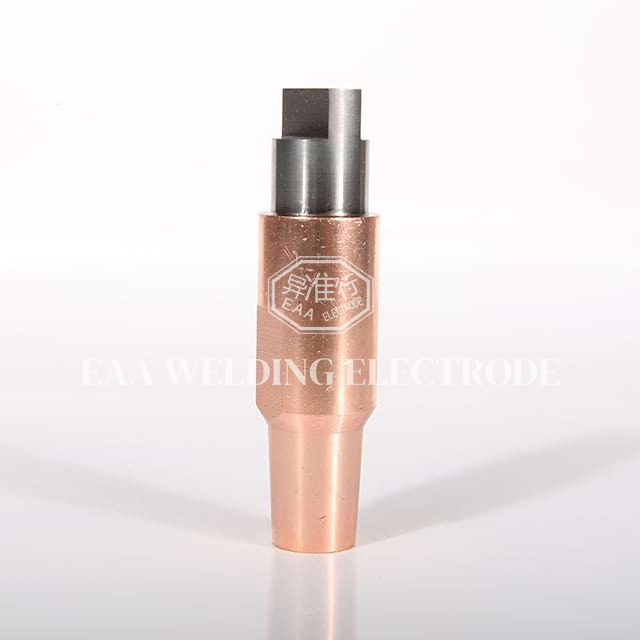
A tungsten copper inlaid electrode explains the structural advantage perfectly. You get a standard copper body for bulk heat dissipation. We pair this with an inlaid tungsten or WCu tip. This places intense wear resistance precisely at the weld face. It balances thermal management and structural longevity perfectly.
Electrode Material Comparison Summary
Material Type | Softening Temp (°C) | Primary Strength | Best Application |
|---|---|---|---|
CuCrZr | ~500°C | High conductivity, affordable | Low-carbon steel, uncoated metals |
Cu-Al2O3 | ~900°C | Anti-adhesion, thermal stability | Galvanized steel, coated metals |
WCu / WMo | >1000°C | Extreme hardness, high resistance | Copper wire, battery tabs, brass |
Inlaid WCu | Hybrid | Wear resistance + heat dissipation | High-volume automation cells |
You cannot use a universal approach. The electrical properties of your workpiece dictate your material choice.
Welding Carbon Steels and Stainless Steel
We recommend standard copper alloys, specifically CuCrZr. Steel possesses high electrical resistance naturally. It generates heat easily at the joint when current passes through. This physical reality makes steel highly forgiving. Standard copper electrodes handle these runs efficiently without premature failure.
Welding Galvanized and Coated Steels
We strongly recommend Alumina Copper for these applications. The zinc coating on galvanized steel melts quickly and aggressively attacks standard copper. Alumina Copper resists this chemical reaction. It mitigates zinc pick-up. You drastically reduce your tip dressing frequency and eliminate sticking issues.
Welding Copper, Brass, and Aluminum
We mandate WCu or WMo for these materials. Copper and aluminum are highly conductive. If you use a highly conductive electrode on a highly conductive workpiece, you fail to generate heat at the interface. You must use highly resistive electrodes. This resistance forces the heat generation at the joint, ensuring a deep, solid weld nugget.
Best Practice: Always conduct a peel test when changing workpiece materials. Visual inspections cannot verify the nugget diameter when working with aluminum or coated steels.
Your supply chain directly impacts your weld consistency. You must thoroughly vet your manufacturing partners.
Quality Control and Material Purity: We advise buyers to demand metallurgical certifications. Impurities in a WCu batch or improper dispersion in Alumina Copper ruin performance. Poor purity drastically reduces electrode life and causes unpredictable failures.
Precision Machining Capabilities: The geometry of the tip is just as critical as the alloy. Whether you need a flat, pointed, eccentric, or radius tip, precision matters. Assess your supplier's ability to hold extremely tight tolerances on custom shapes.
Supply Chain and Scalability: Evaluate their lead times closely. A custom welding electrode supplier must have the capacity to provide consistent batches. High-volume automotive or electronics manufacturing requires guaranteed stock availability.
Prototyping and Sampling: We recommend initiating a pilot run before signing large contracts. Trustworthy suppliers gladly provide samples. You use these samples to validate dressing frequency and weld parameters before full-scale adoption.
There is no universal best material in resistance spot welding. Your selection relies on a strict calculation of workpiece conductivity, required pressure, and acceptable dressing intervals. You must match the alloy's thermal and electrical properties to the specific challenges of your assembly line.
We advise engineering teams to audit their current scrap rates immediately. Review your daily tip dressing schedules carefully. You must determine if transitioning from standard copper to a more advanced WCu or an inlaid solution is justified for your production environment. Often, upgrading the material eliminates expensive bottlenecks.
We encourage you to contact our engineering team with your specific workpiece materials and thickness requirements. Provide your parameters, and we will deliver a data-backed material recommendation or help you request a custom sample.
A: The primary difference lies in their softening temperatures and anti-adhesion properties. Chromium Zirconium Copper softens around 500°C and is ideal for clean, uncoated steel. Alumina Copper softens near 900°C. Its dispersion-strengthened structure resists alloying with zinc, making it the superior choice for welding galvanized steel without sticking.
A: You should upgrade when standard copper tips wear out too fast, but solid tungsten copper is too expensive. Inlaid electrodes provide the extreme wear resistance of a tungsten tip right at the weld face, while the copper body quickly dissipates heat and keeps the unit cost manageable.
A: Sticking usually results from a metallurgical reaction called alloying. When welding galvanized steel, low-melting zinc bonds with standard copper electrodes. To fix this, upgrade to an Alumina Copper electrode, which chemically resists zinc pick-up, or adjust your cooling parameters to keep the tip temperature lower.
A: Tip dressing frequency depends entirely on the material's high-temperature hardness. Softer metals deform and "mushroom" quickly under intense clamping pressure and heat. Materials with higher softening temperatures maintain their shape longer, drastically reducing how often operators must stop production to reshape the tips.


