


Views: 0 Author: Site Editor Publish Time: 2026-10-03 Origin: Site


Premature consumable failure drains shop profitability through hidden expenses. Unplanned downtime, ruined workpieces, and escalating operational costs hurt your bottom line. Every plasma nozzle has a finite lifespan. However, blowing through them in minutes points to systemic operational errors or fundamental supply chain flaws. When a part blows out unexpectedly, it halts production entirely. Operators spend valuable time swapping components instead of cutting metal. This guide uncovers the physical dynamics behind consumable wear. We examine the main culprits destroying your parts. You will learn how to diagnose root causes directly on the shop floor. Finally, you will discover actionable steps and a proven evaluation framework. By upgrading your consumables and refining your process, you can extend part life, boost daily productivity, and lower your true operational expenses permanently.
Up to 80% of premature plasma nozzle failures stem from contaminated air supplies (moisture/oil) and improper standoff distances during the pierce.
Mismatched amperage and incompatible consumable parts drastically accelerate orifice degradation.
Upgrading to a precision plasma nozzle manufactured with high-grade copper and hafnium minimizes arc wandering and extends cut life.
Partnering with a vetted plasma nozzle supplier who guarantees tight machining tolerances is more cost-effective than relying on ultra-cheap, inconsistent knockoffs.
Understanding consumable failure requires a quick look at internal torch dynamics. The nozzle constricts ionized gas to create a highly focused cutting arc. This process generates an immense thermal load. Temperatures passing through the orifice often exceed 20,000°C. The copper body must dissipate this intense heat rapidly. If heat transfer fails, the copper melts almost instantly.
The electrode sitting behind the nozzle plays a critical role. It contains an emitter element. Air and oxygen systems rely on hafnium emitters. Tungsten handles nitrogen and argon gas mixes. As you cut, this emitter slowly burns away. It leaves a tiny pit in the center of the electrode. When this pit becomes too deep, the arc loses its anchor point. A wandering arc will strike the inside wall of the Plasma Nozzle. This event destroys the internal geometry.
Operators must distinguish between normal wear and abnormal failure. Normal end-of-life wear leaves the orifice slightly out of round. However, the wear remains uniform. You might see a gentle widening of the hole. Abnormal failure looks violent. You will notice distinct blowouts, heavy internal gouging, or deep pitting. These severe symptoms indicate an unstable cutting environment. Identifying these visual cues helps you troubleshoot the core problem.
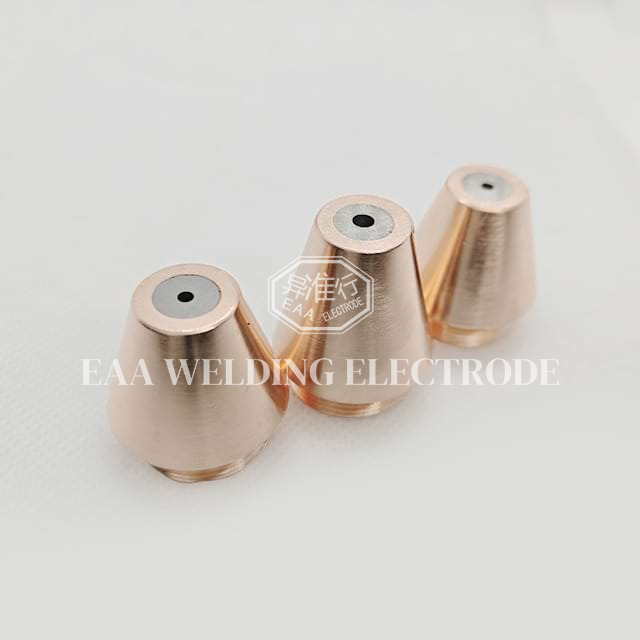
Diagnostic Guide: Plasma Nozzle Wear Symptoms and Causes
Symptom | Visual Indicator | Root Cause |
|---|---|---|
Rapid arcing and sputtering | Blackened burn marks inside the orifice | Contaminated air supply (moisture/oil) |
Immediate double-arcing | External slag buildup on the shield | Improper piercing height (Blowback) |
Wide, sloppy kerf | Elongated, blown-out orifice | Amperage and parameter mismatch |
Severe beveled cuts | Off-center wear inside the nozzle | Worn swirl ring or related consumables |
Clean air is essential for a stable plasma arc. Unfortunately, shop compressors often push moisture, oil, and particulates into the air line. These foreign substances act as a conductive bridge inside the torch. They alter the electrical path of the plasma stream.
The arc relies on pure gas resistance to stay centered. Contaminants cause the arc to short-circuit against the copper wall. You will notice blackened burn marks inside the component. The torch will likely sputter and misfire. Filtering your air supply properly eliminates this frequent failure point.
Piercing too close to the metal plate causes immediate damage. When the arc first strikes the metal, it creates a pool of molten slag. If the torch sits too low, the expanding gas forces this slag directly upward. The molten metal splashes onto the shield and orifice.
This phenomenon is known as blowback. The slag hardens and creates a new electrical path. This leads to immediate double-arcing. The arc splits and destroys the copper body within seconds. Always maintain the manufacturer's recommended standoff distance during the initial pierce.
Every consumable part is engineered for a specific amperage range. Running a 40-amp nozzle at 60 amps pushes too much energy through a small hole. The arc widens rapidly under the excessive current. It melts the copper orifice effortlessly.
Moving the torch too slowly also causes intense heat buildup. The arc searches for new material to burn. It expands laterally and damages the internal walls. The primary symptom is an elongated, blown-out orifice. Operators must verify their machine settings match their installed consumables perfectly.
A torch operates as an integrated system. Reusing a worn-out swirl ring disrupts the entire cutting process. The swirl ring creates a precise gas vortex. This vortex centers the arc dynamically as it passes through the plasma cutting nozzle.
A damaged swirl ring or a cracked O-ring creates turbulent gas flow. The arc leans to one side. You will see off-center wear inside the copper body. This directly causes beveled cuts and angled edges on your workpieces. Replace related consumables periodically to protect your primary parts.
The pilot arc establishes the initial electrical connection. It bridges the gap before transferring to the metal plate. Some operators fire the torch in the air repeatedly. They do this to test the spark or clear the line.
This practice eats the orifice away incredibly fast. The pilot arc transfers intense heat directly into the copper. The torch relies on the main transfer to push heat into the workpiece. Firing without transferring acts like a localized explosion inside the torch body. Train operators to avoid this damaging habit.
Many procurement managers fall for the illusion of cost savings. Buying bulk, low-cost off-brand nozzles looks great on a spreadsheet initially. However, this strategy results in much higher overall operational costs. Cheap parts fail quickly. You face frequent changeouts, wasted labor hours, and ruined base materials.
Material quality matters significantly in high-heat applications. Low-grade alloys cannot handle continuous thermal shock. In contrast, a true precision plasma nozzle utilizes highly conductive copper. It also integrates premium hafnium inserts. These high-grade materials maintain their structural integrity far longer. They focus the arc cleanly and consistently.
Machining tolerances also separate good parts from bad ones. Cheap manufacturing processes leave micro-inconsistencies inside the orifice. Even a tiny burr disrupts the gas flow vortex. Poor flow creates off-center arcs and immediate part failure. Tight tolerances ensure a straight, narrow arc every single time.
You must change your evaluation metric. Frame the purchasing decision around "Cost per Foot of Cut" instead of "Cost per Nozzle". A premium part might cost slightly more upfront. Yet, if it cuts three times as much metal, it is undeniably cheaper. You save money on labor, reduce scrap rates, and increase machine uptime.
Finding a trustworthy partner requires looking beyond the price tag. Batch consistency and strict quality control are paramount. You should investigate a vendor's manufacturing standards closely. Look for ISO certifications. Ask if they use automated optical inspection during production. These processes guarantee that every orifice measures exactly to specification.
Compatibility guarantees are equally vital. Ensure your chosen plasma nozzle supplier provides components matching OEM torch specifications exactly. Even slight deviations in internal geometry cause gas flow disruption. A reliable vendor will stand behind their fitment and performance claims.
Technical support and transparency indicate a strong partner. A trustworthy supplier helps you troubleshoot wear issues. They analyze your failed parts to find the root cause. They do not just push more products onto your shelves. Look for clear material specifications and highly responsive customer service.
Watch out for obvious red flags in the industry. Avoid vendors with opaque sourcing channels. Reject suppliers if you experience unusually high defect rates in sample batches. Finally, walk away if a company lacks a clear return policy for defective consumables. Your production line cannot afford unreliable supply chains.
Changing your parts provider is only half the battle. You must control your shop floor environment to maximize part longevity. Follow this structured plan to protect your new consumables.
Air Quality Audit: Inspect your compressor lines immediately. Install high-quality coalescing filters near the machine. Use refrigerated dryers or desiccant systems to eliminate moisture. Drain your tanks daily to prevent water accumulation.
Operator SOPs (Standard Operating Procedures): Mandate proper pierce heights for every job. Use a drag shield or automated Torch Height Control (THC) systems. Never pierce at the cut height. Strictly match your consumable amperage to the machine dial setting.
The "Whole Stack" Replacement Rule: Establish strict inspection guidelines. Check the electrode, swirl ring, and retaining cap together. Change them as a complete system when necessary. Never pair a brand-new nozzle with a deeply pitted electrode.
Routine Maintenance Logging: Track exactly how many hours each set lasts. Note any anomalies in cut quality. Use this data to identify trends and catch machine faults early.
Rapid consumable wear is a solvable problem. It usually stems from poor operational parameters or sub-par manufacturing quality. By understanding arc dynamics and recognizing visual symptoms, you can stop wasting expensive parts. Clean air, correct pierce heights, and proper amperage settings form the foundation of efficient cutting.
It is time to change your perspective on these components. Stop treating plasma parts as disposable afterthoughts. Start treating them as precision tools essential to your success. High-quality parts deliver superior edge quality and reduce secondary grinding labor.
Take action on your shop floor today. Audit your air supply to eliminate moisture and oil. Verify your pierce heights on the next production shift. Finally, request a sample batch from a high-quality supplier. Run a true side-by-side longevity test. You will clearly see the operational value of precision engineering.
A: It depends heavily on material thickness, pierce count, and air quality. A realistic baseline is roughly one to two hours of continuous arc time. Under optimal conditions, expect about 200 to 300 pierces. Continuous cutting extends lifespan compared to frequent piercing.
A: You can sometimes chip off external slag carefully. However, you must inspect the orifice. If it is deformed or shows internal pitting, discard it immediately. Reusing a damaged part will ruin your cut quality. It can also cause severe damage to the torch body.
A: Yes. Thicker materials require longer pierce times. This significantly increases your blowback risk. Furthermore, highly reflective metals like aluminum alter the heat dynamics inside the torch. Operators must adjust standoff distances and piercing techniques to prevent premature failure when switching materials.


