


Views: 0 Author: Site Editor Publish Time: 2026-03-20 Origin: Site


Why do stable weld settings still lead to weak joints, rising scrap, and unexpected downtime? In many plants, a Resistance Welding Electrode is still treated as a basic consumable, even though it directly affects heat, force, cooling, and weld consistency. In this article, you will learn how electrode quality shapes weld results, costs, and long-term production stability.
A resistance welding electrode does far more than complete an electrical path. It also presses the workpieces together with stable force. At the same time, it pulls heat away from the weld zone after current flow. Its shape controls contact area, current density, and nugget formation. If any of those functions become unstable, weld quality starts to drift.
This is why electrode quality has a direct process role. It is not separate from weld quality. It is part of weld quality. In practice, a poor electrode can damage consistency even when the machine is sound and the settings appear correct.
Resistance welding depends on force, current, and weld time. These variables are often treated as control settings only. In reality, electrode condition helps determine how those settings behave at the joint. A worn tip changes contact area. A dirty taper raises resistance where it should not. Weak cooling changes the thermal cycle from one weld to the next.
That means the control panel may show the same setup, while the real weld condition changes. This is why some lines feel unstable without any obvious machine fault. The settings did not move, but the effective process did.
Electrode problems often begin as small issues. A slightly mushroomed tip may not look serious. A missing water tube may seem minor. A loose or oxidized connection may go unnoticed during a busy shift. Yet each one can shorten cap life, reduce weld strength, and increase downtime.
The cost pattern is usually indirect. Plants consume more caps. They spend more time dressing tips. Operators add current to compensate. Scrap rises, and throughput falls. What began as a low-cost part issue becomes a production cost issue.
When weld quality drops, teams often look at parameters first. They may also blame sheet variation, operator error, or a weak transformer. Those checks matter, but they are not always the right starting point. Electrode condition is often the faster answer. It can change the process without changing the programmed setup.
This makes troubleshooting harder. The defect appears downstream, but the cause sits at the contact point. If no one checks the electrode, the line may keep running in an unstable state for days.
Resistance welding is fast and localized. Because of that, small changes at the contact surface matter a lot. A poor fit, worn tip, or cooling problem can shift heat concentration quickly. The result may be expulsion, weak nuggets, or internal voids.
The process also hides some failures well. A surface mark can look normal even when fusion is weak. That is why electrode quality deserves more attention than many plants give it.
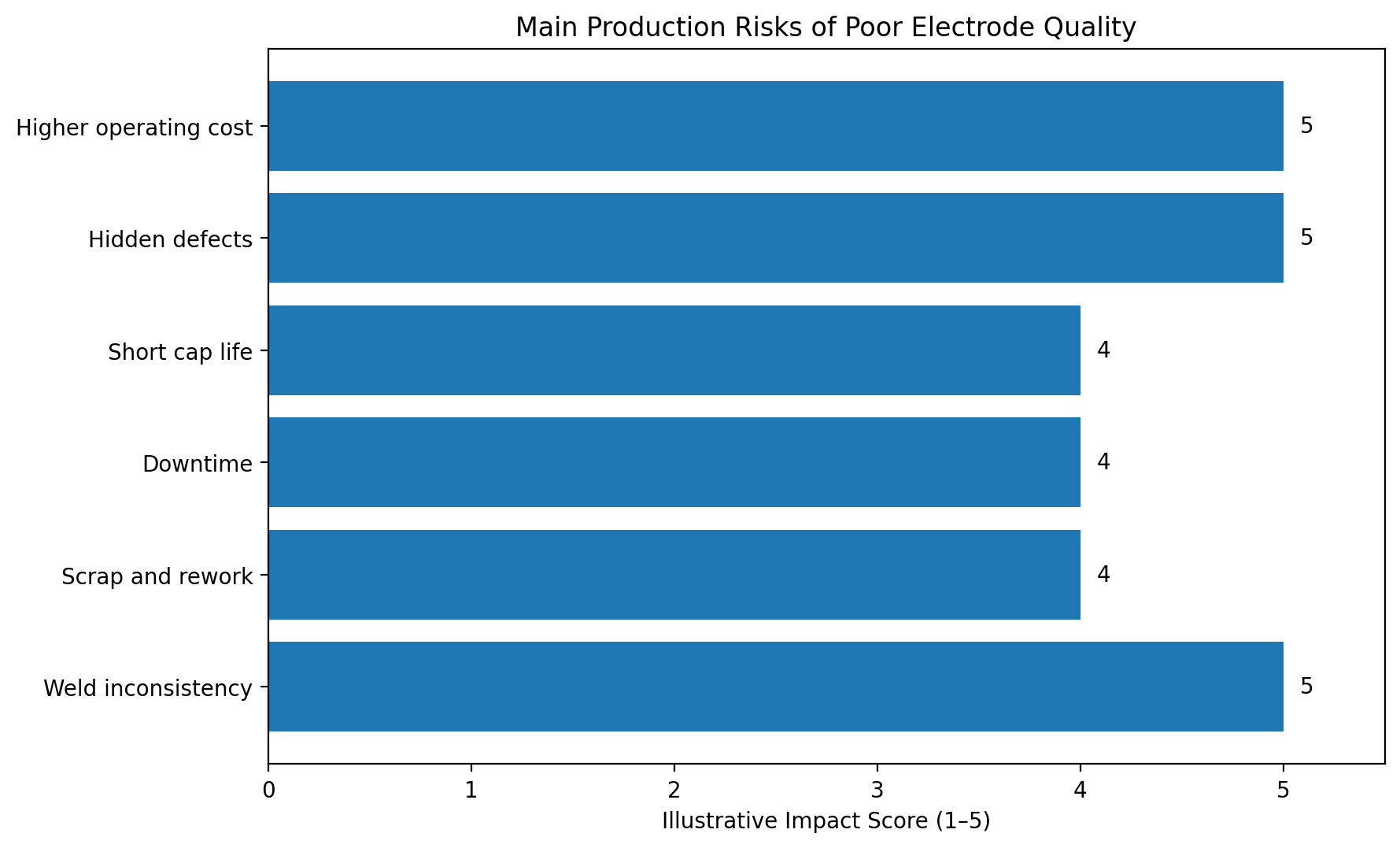
When plants ignore electrode quality, they often pay in several ways at once. They buy more consumables, but get less life from each one. They lose time to unplanned stops and repeated dressing. They may also reject parts late, after labor and material are already spent. In severe cases, unstable welds can reach customers and create warranty risk.
A better mindset is simple. Treat the resistance welding electrode as a controlled process variable. When you do that, you reduce both visible and hidden costs.
Expulsion often signals unstable heat balance. When the tip is worn, mismatched, or poorly cooled, current density can shift in the wrong way. Heat builds too fast at the interface, and molten metal is forced out. That hurts nugget integrity and creates visible surface damage.
Operators may try to lower current after this appears. Sometimes that helps for a short time. However, if the real cause is poor electrode condition, the defect will return.
A weak nugget often starts with poor contact quality. Oxidized tapers, damaged holders, and bad seating reduce current delivery. The machine may still cycle normally, but less effective amperage reaches the weld. That leaves a small or weak nugget, even if timing looks correct.
This is one reason why visual checks alone are risky. A weld may look centered and clean. Yet destructive testing may show poor strength.
When electrode geometry changes, force and heat no longer spread as intended. That can create deep marks, sticking, or poor release after welding. Overheated tips also soften faster and wear even more. The process then becomes progressively less stable over time.
This issue is often misread as a material problem. In reality, the electrode may already be far outside its best working shape. Dressing and replacement schedules should prevent that drift.
Poor cooling and unstable thermal input can create defects inside the weld. Shrinkage voids and crack-prone structures may form during solidification. These problems are hard to confirm from the surface alone. They usually appear later during testing or service.
That is why electrode condition matters beyond appearance. It influences the full heating and cooling cycle. If that cycle is unstable, internal reliability suffers.
An off-center electrode does not apply force evenly. It also changes how current enters the workpieces. One side may overheat, while the other side underperforms. That can create wide variation in weld strength across the same shift.
Uneven wear makes this worse. The electrode may still look usable at a glance. Yet its working face no longer supports repeatable contact.
Fast cap failure does not always mean poor cap material. It may point to weak cooling, bad alignment, dirty seating surfaces, or a mismatch between electrode type and workpiece. Replacing caps without finding the deeper cause only hides the pattern. The line may keep burning through consumables without solving anything.
A short cap life is therefore a warning sign. It should trigger a process review, not just another purchase order.
Weld Symptom | Likely Electrode-Related Cause | Production Effect |
Expulsion | Worn tip, poor cooling, low force stability | Scrap, surface damage, rework |
Weak nugget | Dirty taper, poor contact, bad fit | Failed strength tests, rejects |
Excessive indentation | Wrong geometry, overheating, sticking | Cosmetic damage, shortened cap life |
Inconsistent welds | Misalignment, uneven wear | Variable quality, unstable output |
Rapid cap failure | Cooling or material mismatch | Higher consumable cost, downtime |
Electrode material should match the job, not just the machine. Different metals place different demands on conductivity, hardness, and wear resistance. Copper alloys are common because they conduct current and heat very well. Yet one alloy does not suit every application equally well. Stainless steel, coated steels, wire products, and heavier sections may all respond differently.
A strong choice balances electrical performance and service life. If the alloy is too soft, wear rises quickly. If it is too hard for the application, heat behavior may become less favorable.
Tip diameter directly affects current density. A smaller contact area raises heat concentration. A larger one spreads current and force over a wider zone. Neither is always better. The right size depends on sheet thickness, weld size target, surface marking limits, and cycle demands.
This is why standard diameter rules should be applied carefully. A tip that works well on one part may perform poorly on another. The geometry must support the actual workpiece, not only past habit.
Standard designs reduce process variation. They are easier to source, easier to replace, and easier to compare across lines. They also simplify training for operators and maintenance teams. When plants use too many special shapes, troubleshooting becomes harder and replacement becomes slower.
Custom designs still have a place. However, they should solve a clear application need. They should not become the default choice without a solid reason.
Some plants try to simplify inventory by using one style almost everywhere. That usually creates compromises. Thin sheet, wire basket work, stainless parts, and high-volume spot welding do not all need the same electrode face, alloy, or size. A one-style approach may work acceptably in one area and poorly in another.
Better standardization is smarter, not broader. Group similar jobs together and define the best electrode for each family.
Application Need | Electrode Choice Priority | Main Risk if Mismatched |
Thin sheet | Controlled contact area and stable heat | Burn-through or deep marking |
Heavy sections | Strong force support and wear resistance | Weak fusion or short cap life |
Stainless steel | Balanced heat control and stable force | Expulsion or surface damage |
High-volume production | Long life and repeatable geometry | Frequent changeovers and drift |
Even a good alloy will struggle without proper cooling. As copper gets hotter, it loses some conductivity. That change reduces output stability and shortens electrode life. Good water flow helps control temperature, protect geometry, and support repeatable weld formation.
Many plants focus on water temperature only. Flow consistency is often just as important. A stable cooling system supports stable weld performance and longer service life.
Water problems often hide inside the system. Clogged lines, mineral buildup, broken tubes, and poor routing reduce cooling where it matters most. Some water may still move, but not enough reaches the tip area. The electrode then overheats, softens, and fails early.
This is why cooling checks should be physical, not assumed. A healthy chiller does not guarantee healthy tip cooling. The full path must work correctly.
Tip dressing restores the intended contact face. It helps maintain current density and surface condition from cycle to cycle. Without regular dressing, the face mushrooms, marks deepen, and heat balance drifts. Operators then compensate by changing current or force, which often makes the process less stable.
A good dressing plan should be scheduled, not reactive. If teams wait too long, the line works harder to produce weaker results.
Some of the worst problems come from routine shortcuts. Dirty tapers reduce conductivity. Leaking holders harm cooling and contact. Improper sealing methods can insulate connections instead of helping them. Even a small repair choice can interrupt current flow in a low-voltage system.
Good maintenance in resistance welding is precise work. Clean surfaces, correct fit, proper replacement parts, and leak-free connections all matter if the process is expected to remain stable.
When weld strength falls, operators often raise current first. That may restore results briefly, but it does not solve the root cause. If the tip is worn or poorly cooled, extra current usually increases expulsion, indentation, and cap wear. The line may appear fixed for a short period, then become even less stable.
A process fix should not hide a hardware problem. Stable production needs both the right settings and the right electrode condition.
Air cylinders, servos, springback, and incomplete squeeze can all reduce effective force. Those problems may look like electrode failure because the weld result is similar. Parts may show expulsion, sticking, or weak fusion. That is why force delivery should be checked during troubleshooting.
Still, force issues and electrode issues often interact. A poor electrode makes a force problem worse, and a force problem makes a worn electrode more harmful.
Timing functions only work well when the electrode reaches the part correctly. If squeeze is short and contact is incomplete, current may start too early. If cooling is poor, hold time may not support solidification as expected. The control may be modern and accurate, but the contact condition still shapes the outcome.
This is an important mindset shift. Controls manage sequence, but the electrode controls the physical interface where the weld is formed.
A healthy process usually has some tolerance. When electrode condition is stable, the weld lobe is wider and easier to hold. As the electrode degrades, that safe window gets smaller. Minor drift in force or current then causes bigger weld changes.
This is why poor electrode quality makes a line feel sensitive or unpredictable. The process has less room for normal variation.
Good monitoring begins with trends. Cap life alone is not enough. Dressing frequency, defect rate, and weld strength variation should also be reviewed together. These patterns show whether the electrode system is stable or drifting.
This helps plants move from reaction to prevention. Instead of waiting for obvious failure, they can act when performance starts to decline.
Resistance welding often hides weak fusion. Because of that, periodic destructive testing remains important. Peel tests, chisel tests, and similar checks can confirm whether the nugget is forming as expected. They also validate whether recent changes improved the process.
Visual appearance should support quality checks, not replace them. A clean mark is not proof of a strong joint.
Modern monitoring tools add another layer of confidence. Current monitors can confirm output. Force checks can verify delivery. Thermal imaging and related tools can help identify abnormal heating and cooling patterns in demanding applications. These tools do not remove the need for maintenance, but they make drift easier to catch.
Plants do not need to monitor everything at once. They need the right checks at the right points in the process.
A good program stays simple and repeatable. Check taper cleanliness. Confirm water flow. Inspect alignment. Review wear limits. Verify that holders, tubes, and cables are in sound condition. These steps are basic, but they protect the full process.
When inspection points are clear, teams act faster and argue less. That alone saves time on the floor and makes maintenance more effective.
What to Monitor | Why It Matters | Simple Action |
Cap life | Shows wear rate and cooling health | Compare by shift or job |
Dressing interval | Reveals geometry stability | Standardize by cycle count |
Water flow | Protects conductivity and tip life | Check flow path and blockages |
Alignment | Maintains even force and heat | Inspect after changeovers |
Destructive test results | Confirms real weld strength | Review at planned intervals |
Resistance welding electrode quality drives weld strength, cap life, and process stability. Better selection, cooling, dressing, and monitoring reduce scrap, downtime, and hidden defects. Guangzhou Yizhunxing International Trade Co., Ltd. provides reliable electrode solutions and practical supply support, helping manufacturers improve consistency, extend service life, and lower total operating cost.
A: A Resistance Welding Electrode carries current, applies force, removes heat, and shapes the weld.
A: Poor Resistance Welding Electrode quality can cause expulsion, weak nuggets, fast cap wear, and unstable welds.
A: Use proper cooling, regular dressing, clean tapers, and correct alignment.
A: No. Low-cost options may increase scrap, downtime, maintenance, and total operating cost.


