


Views: 0 Author: Site Editor Publish Time: 2026-03-19 Origin: Site


In modern manufacturing, weld quality often depends on the Resistance Welding Electrode. Selecting the right electrode ensures strong, durable, and consistent welds while preventing sticking and uneven penetration. In this guide, you will learn about electrode types, materials, shapes, and maintenance practices to optimize welding performance, improve efficiency, and reduce production errors.
A resistance welding electrode is a conductor designed to carry electrical current while applying precise pressure to the workpieces. Its role is to generate enough heat through electrical resistance to form a weld nugget while maintaining structural integrity. The electrode’s conductivity, hardness, and thermal properties all influence weld quality. Poorly selected electrodes can deform, overheat, or fail to produce a consistent weld, making understanding electrode function critical for industrial applications. Proper electrode selection ensures uniform heat distribution, reliable nugget formation, and minimal surface damage to the workpiece.
Electrodes fall into two main categories: consumable and non-consumable. Consumable electrodes, often copper-based, partially melt during welding and contribute to the weld material, which is useful in spot and projection welding. Non-consumable electrodes, such as tungsten or molybdenum, remain intact and conduct current while a separate filler metal is used. Each type has distinct advantages depending on the base material, welding process, and desired weld characteristics. For example, consumable electrodes are preferred for steel, whereas non-consumable electrodes excel in aluminum or titanium applications.
Electrode materials greatly impact welding performance. Copper alloys provide high conductivity and moderate hardness, ideal for general-purpose welding. Tungsten offers excellent heat and wear resistance for high-current operations, while molybdenum combines machinability with thermal stability, making it suitable for exotic metals. Key properties to consider include electrical and thermal conductivity, Rockwell hardness, resistance to deformation, and oxidation resistance. Matching these properties to the welding application ensures consistent nugget formation, minimal sticking, and extended electrode life.
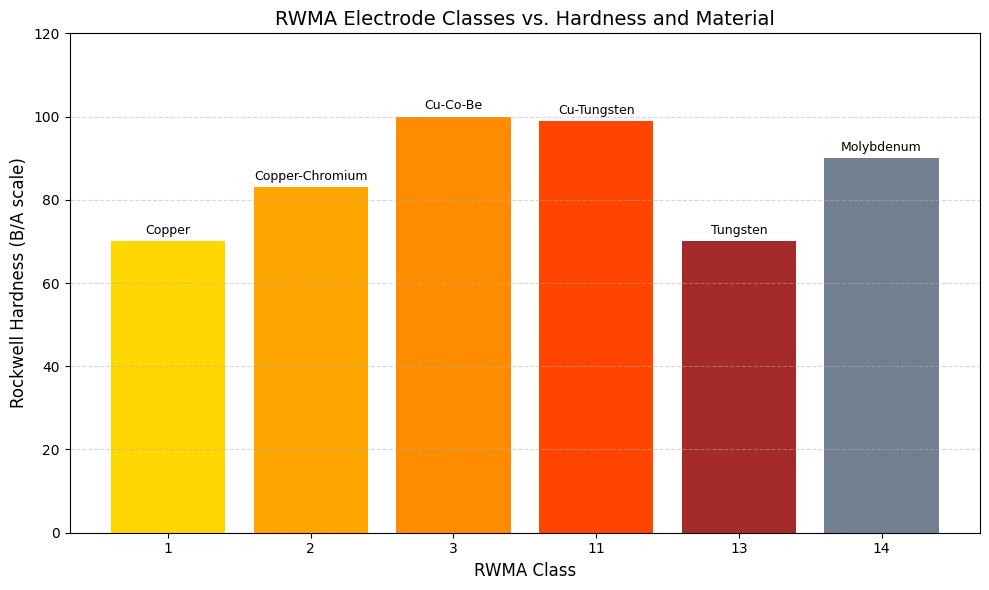
The Resistance Welder Manufacturers Association (RWMA) provides standardized classes for electrode materials to ensure compatibility and predictable performance. Classes 1-3 cover copper-based alloys for low- to medium-resistance metals, Classes 11-14 cover copper-tungsten, tungsten, and molybdenum alloys for high-strength or refractory applications. Using RWMA classifications simplifies material selection and ensures reliability in both high-volume production and specialized welding tasks.
RWMA Class | Material | Hardness | Conductivity | Typical Use |
1 | Copper | 70B | 90% | General steel, low-resistance metals |
2 | Copper Chromium | 83B | 85% | Steel, nickel alloys |
3 | Copper Cobalt Beryllium | 100B | 48% | High-force welding, resistive materials |
11 | Copper Tungsten | 99B | 46% | Precious metals, copper alloys |
13 | Tungsten | 70A | 32% | Copper, brass, high-heat applications |
14 | Molybdenum | 90B | 31% | Copper, gold, silver, alloys |
Copper-based electrodes, including RWMA 1, 2, and 3, are highly versatile. RWMA 1 electrodes provide excellent conductivity and are cost-effective for low-resistance metals like aluminum and brass. RWMA 2 offers higher hardness for steel and nickel alloys, resisting wear under higher welding forces. RWMA 3 electrodes combine durability and hardness, ideal for resistive metals and high-current applications. Copper-based electrodes are widely used in automotive and electronics manufacturing, where precise heat control and consistent weld nuggets are critical.
High-strength electrodes withstand extreme heat and mechanical stress. Copper-tungsten alloys provide machinability for custom shapes while maintaining high durability. Tungsten offers unmatched heat resistance but requires grinding for shaping. Molybdenum can be machined for specific geometries and performs well with high-conductivity metals like copper and silver. These alloys are essential for aerospace, electrical, and high-precision industrial applications where weld quality cannot be compromised.
Specialty coatings improve electrode performance. Zirconium enhances arc stability for aluminum welding, thorium increases electron emission and arc longevity, and Glidcop alloys combine copper with aluminum oxide particles to resist thermal softening and wear. Coatings extend electrode life, reduce sticking, and enable stable welding in high-volume production. Coated electrodes are particularly valuable in battery manufacturing, electronic components, and stainless steel fabrication.
Electrode geometry directly affects weld quality. Spot welding uses pointed or flat faces to control nugget size, projection welding requires wider faces to support studs or nuts, and seam welding uses rotating wheels for continuous welds. Different nose profiles—C, D, F, or flat—allow welders to prevent surface damage, break oxide layers, or reach confined spaces efficiently. Proper electrode shape ensures uniform heat distribution, consistent penetration, and minimizes defects.
Welding Type | Electrode Shape | Nose Profile | Application |
Spot | Pointed / Flat | C, D, F | Small welds, tight corners |
Projection | Flat / Wide | Flat | Studs, nuts, high-force welding |
Seam | Wheel | Round | Continuous sheet welding |
Electrode and base metal compatibility prevents sticking, uneven heat, and poor penetration. Copper-based alloys work for steel and aluminum, while refractory metals handle high-resistance or exotic materials. For dissimilar metals, adjust weld face size or electrode resistance to balance heat distribution. Correct material selection ensures strong welds and reduces production delays.
The weld face must be larger than the nugget size specified in engineering drawings. Thicker metals require wider faces to prevent nugget bias toward thinner sheets. Adjustments in diameter and shape maintain proper heat distribution and avoid weld defects, particularly in multi-thickness or high-conductivity applications.
Electrodes need high electrical conductivity to minimize heat loss and low thermal retention to prevent overheating. Proper material selection ensures consistent welds and extends electrode life. For high-volume production, balancing conductivity and durability is essential to reduce maintenance and downtime.
Electrodes may use internal water cooling or external jackets. Flow rates of 0.5–1.5 gal/min are typical. Routine reshaping, cleaning, and surface inspections prevent burn marks and deformation. Effective cooling and preventive maintenance maximize electrode longevity and maintain weld quality over repeated cycles.
Maintenance Task | Recommended Action | Frequency |
Water Cooling | 0.5–1.5 gal/min, clean water | Daily during production |
Face Reshaping | Grind or polish to original profile | Weekly or as worn |
Surface Cleaning | Remove debris and oxidation | Daily |
Inspection | Check for burn marks or cracks | Every shift |
High copper alloys provide excellent conductivity, corrosion resistance, and wear performance. They sustain consistent weld quality under high temperatures, which is essential in automotive and electronics applications. Their durability reduces downtime and replacement costs, making them ideal for both high-speed and high-precision welding.
Pointed high copper electrodes control nugget size in thin materials or high-resistance metals. Alloys such as AMPCOLOY® 88 and 91 handle stainless steel, nickel, and nichrome efficiently. Proper alignment and tip maintenance ensure consistent penetration and minimize spatter.
Wheel-shaped copper alloy electrodes enable continuous welds in seam welding while maintaining uniform heat. Water-cooling prevents thermal softening during high-speed operations. In projection welding, copper alloys concentrate current on small contact points, ensuring strong and precise joins on studs and nuts.
Mild and carbon steel welding benefits from AMPCOLOY® 972 or 940, while stainless steel requires AMPCOLOY® 95. Selection depends on metal type, thickness, and desired weld speed. Proper alloy choice maximizes electrode life, reduces downtime, and improves weld consistency.
Pre-weld cleaning removes oxides, oil, or coatings that impede current flow. Preheating improves penetration and prevents cracking. Electrode alignment ensures uniform pressure, avoiding uneven welds. Consistent pre-weld preparation is critical for reducing rework and improving overall production quality.
Current, pressure, and weld duration must be carefully controlled. Adjustments are necessary for varying material thicknesses or dissimilar metals. Monitoring ensures weld nugget uniformity, prevents burn-through, and minimizes post-weld defects.
Visual and non-destructive inspections verify weld integrity. Look for cracks, spatter, and uneven penetration. Post-weld cleanup ensures smooth surfaces and prepares components for further assembly or coating processes.
Electrode sticking or burn marks typically occur due to incorrect material selection, excessive welding current, or misalignment between the electrode and workpiece. These issues can cause uneven heat distribution, reduced weld quality, and increased wear on the electrode. Effective solutions include selecting a compatible electrode alloy for the base metal, carefully adjusting weld current and pressure, and reshaping the electrode faces to restore their original geometry. Regular monitoring during welding helps prevent repeated sticking issues and ensures consistent welds.
Electrodes may deform or wear excessively under high welding forces, poor cooling, or lack of routine maintenance. Over time, this reduces weld consistency and may require frequent replacements. Using harder alloys or high-strength copper alloys, combined with proper water-cooling and regular reshaping, significantly reduces wear. Maintaining the correct alignment and pressure during welding also preserves electrode geometry and extends service life, which is particularly important in high-volume production environments.
Uneven weld nuggets often result from differences in material thickness, resistance, or improper electrode sizing. A nugget that is offset toward a thicker sheet can compromise weld strength and aesthetics. Balancing heat distribution can be achieved by adjusting the electrode face size, selecting appropriate electrode materials, or modifying welding parameters such as current and pressure. Consistently reviewing welds and making minor adjustments ensures uniform nugget formation and avoids structural weaknesses in the finished joint.
Inadequate cooling is a common cause of reduced electrode lifespan and inconsistent weld quality. Electrodes should be cooled with a steady flow of clean water, inspected regularly for damage or deformation, and replaced when necessary. Proactive maintenance, including reshaping and surface cleaning, helps preserve electrode performance, prevents overheating, and reduces production downtime. Ensuring proper cooling is especially critical in continuous or high-current welding operations.
High-conductivity metals such as copper, brass, and nickel alloys require electrodes with specialized materials and coatings to prevent sticking and premature wear. Selecting the appropriate electrode alloy and nose profile ensures proper heat distribution and optimal weld penetration. Careful attention to these details enables precise, high-quality welds even in challenging materials, reducing scrap and improving overall productivity.
Applications involving projection welding, thick materials, or high-current operations demand reinforced electrodes capable of handling extreme forces. Adequate cooling, proper alignment, and robust alloy selection are critical to maintain weld integrity. These precautions prevent deformation, minimize electrode wear, and ensure consistent weld quality under demanding conditions.
Machining and coating electrodes for unique geometries allow welders to optimize weld performance for specialized components. Custom solutions improve accuracy, reduce rework, and extend electrode lifespan. Industries such as aerospace, electronics, and high-precision manufacturing benefit greatly from tailored electrodes designed to meet their specific welding requirements.
Automated and robotic welding systems require electrodes compatible with holders, cooling channels, and precise movement controls. Properly integrated electrodes reduce scrap, increase production speed, and maintain consistent weld quality. Ensuring compatibility between electrodes and automated equipment maximizes efficiency and reliability, which is essential in high-volume, modern manufacturing environments.
Selecting the right resistance welding electrode ensures strong, durable, and efficient welds. Material compatibility, shape, cooling, and maintenance are key factors. High copper alloys and RWMA-compliant electrodes deliver consistent performance across spot, seam, and projection welding. Guangzhou Yizhunxing International Trade Co., Ltd. provides high-quality electrodes designed for reliability, longevity, and improved industrial productivity. Their products support high-volume, precise welding, helping manufacturers reduce downtime and achieve better results.
A: A Resistance Welding Electrode conducts current and applies pressure to form strong welds in metals.
A: Consider material compatibility, electrode shape, and cooling to select the optimal Resistance Welding Electrode.
A: High heat, improper cooling, or misalignment can cause Resistance Welding Electrode wear and reduce weld quality.
A: Yes, but choosing the right alloy ensures proper heat distribution and prevents sticking or deformation.
A: High copper electrodes offer excellent conductivity, wear resistance, and long life for consistent welds.


