


Views: 0 Author: Site Editor Publish Time: 2026-06-12 Origin: Site


In modern manufacturing, electrode life rarely functions as a fixed number. It acts as a critical variable dictating line uptime, overall weld quality, and ongoing consumable spending. Many facilities struggle to predict when a tip will fail. This unpredictability leads directly to unexpected downtime and inconsistent fusion quality. While a standard Spot Welding Electrode can endure anywhere from 3,000 to over 20,000 welds, actual lifespans vary wildly. Your results depend heavily on workpiece materials, cooling efficiency, and strict maintenance protocols. Treating these consumables as unpredictable creates unnecessary scrap. We wrote this guide to provide production engineers and procurement teams with a practical framework. You will learn how to evaluate electrode performance accurately on the factory floor. We will help you understand common degradation mechanisms thoroughly. Ultimately, you can establish predictable, highly efficient replacement cycles.
Material dictates baseline life: Uncoated low-carbon steel yields 10,000–20,000 welds per electrode, while galvanized steel or aluminum limits life to 3,000–6,000 due to rapid alloy degradation.
Cooling is the ultimate variable: Strict thermal management (e.g., specific water flow rates and temperature deltas) is the most effective engineering control for extending tip life.
Wear is predictable: Implementing a structured tip dressing and current stepping program transforms unexpected electrode failure into planned, manageable maintenance.
Form factor impacts ROI: Transitioning from solid straight electrodes to a "caps and shanks" system can drastically lower consumable costs for high-volume lines.
Uncoated mild steel offers the most forgiving application environment in resistance welding. Standard Chromium-Copper (Cr-Cu) electrodes routinely achieve 10,000 to 20,000 welds before failure. The lack of surface coatings means less thermal friction. It also guarantees minimal alloying risk during the weld cycle. Operators enjoy longer intervals between necessary maintenance stops.
Conversely, galvanized (coated) steel presents immediate, unavoidable challenges. Zinc coatings melt at significantly lower temperatures than the underlying steel structure. This liquid zinc then alloys rapidly with the heated copper electrode. Accelerated wear happens quickly. This chemical reaction typically reduces lifespan to a mere 3,000–6,000 welds. Automotive manufacturers frequently encounter this when fighting rust, leading to a phenomenon known as "brassing." The zinc mixes with the copper, forming a brittle brass layer. This layer eventually flakes off, taking tiny pieces of the copper tip with it and causing severe micro-pitting.
Aluminum alloys are highly thermally conductive. They also carry heavy surface oxidation layers. Welding aluminum requires extreme electrical current and heavy mechanical force. This exact combination triggers rapid aluminum-copper reaction diffusion. Degradation usually occurs through intermetallic compound formation. It can begin within the very first few weld cycles. This severely limits life unless you specify specialized surface coatings. Options like Nickel (Ni) or Titanium Diboride (TiB2) PVD coatings work well. Zirconium-Copper (Zr-Cu) alloys also mitigate this rapid decay.
Decision Lens: Align your lifespan expectations strictly with your material matrix. Overlooking material characteristics will quickly lead you to miscalculate consumable budgets. Do not assume one baseline fits every production line.
Workpiece Material | Recommended Alloy | Expected Lifespan (Welds) | Primary Wear Factor |
|---|---|---|---|
Uncoated Mild Steel | Chromium-Copper (Cr-Cu) | 10,000 – 20,000 | Gradual thermal mushrooming |
Galvanized Steel | Zirconium-Copper (Zr-Cu) | 3,000 – 6,000 | Zinc-copper alloying (brassing) |
Aluminum Alloys | PVD Coated / Spec Alloys | 1,000 – 3,000 | Intermetallic compound formation |
Understanding why a tip fails helps you slow the process down. One primary mechanism is "mushrooming," which leads directly to current density loss. Constant thermal and mechanical stress causes the electrode tip to flatten. The tip gradually widens under repetitive pressure. As surface area increases, electrical current spreads over a much larger footprint. The current density drops significantly. This dispersion leads to weak or completely failed nuggets. You lose the critical fusion required for structural integrity.
Another common issue is metallurgical alloying. Industry professionals often call this "sticking." High peak temperatures cause the workpiece material to diffuse directly into the copper face. This creates a highly resistive barrier layer. It blocks efficient energy transfer during subsequent welds. The tip eventually bonds with the surrounding metal. Operators then must pry the gun open, causing severe geometric damage.
Mechanical impact damage also plays a massive role in tip decay. Aggressive mechanical impact from traditional pneumatic weld guns accelerates tip deformation. Every time the gun slams shut, the copper face absorbs severe kinetic energy. Traditional air cylinders often cause the gun arms to bounce slightly upon initial impact. This micro-bouncing creates electrical arcing before full pressure is achieved. Arcing blows away small fragments of the copper face long before heat damage occurs.
What to watch out for: Operators should perform visual checks for blue or purple discoloration near the tip base. This color change indicates severe overheating. It usually means the internal water cooling tube has retracted or clogged.
Implementation Reality: Wear remains completely unavoidable. The true goal of production engineering is to control the rate of wear. You should never attempt to eliminate it completely.
Precision water cooling standards act as your first line of defense. Proper flow and temperature dictate how well copper resists thermal deformation. Flow rates must hit a minimum of 4L/min for thin, uncoated sheets. For thick or heavily coated materials, ensure rates stay at or above 6L/min.
Temperature controls require strict, constant monitoring. Target an inlet water temperature of ≤20°C. Maintain an outlet temperature of ≤30°C. If the delta exceeds 10°C, your cooling system is underperforming. Internal geometry also matters immensely. Cooling tubes should feature a precise 45° cut angle. They must align closely with the internal face of the tip. This proximity maximizes heat transfer away from the critical contact zone.
Best practices for cooling systems go beyond flow rates. Water quality matters immensely. Hard water creates calcium scaling inside the narrow cooling tubes. A scale buildup of just 1mm can reduce heat transfer efficiency by over 30%. Facilities should use closed-loop treated chiller systems rather than municipal tap water.
Next, prioritize thorough weld parameter optimization. Avoid compensating for poor part fit-up by excessively increasing your current. Adding unnecessary weld time also spikes tip temperatures dangerously. Ensure material thinning at the weld site never exceeds 25% of the total sheet thickness. Excessive pressure thins the metal and stresses the copper. Consider the hold time as well. Keeping the electrodes clamped for an extra fraction of a second after the current stops allows the copper to absorb heat from the fresh nugget.
Finally, consider physical equipment upgrades. Utilizing modern servo-driven weld guns allows for programmed approach speeds. This "soft touch" capability significantly reduces physical impact upon closure. Less kinetic shock effectively extends your tip geometry life.
Production floors often debate current stepping versus tip dressing. "Stepping" incrementally increases welding current. This extra current offsets the mushrooming effect by forcing more energy through a wider tip. "Dressing" physically mills the tip back to its original geometric shape. Both strategies require careful, documented planning.
Here are the necessary steps to build a reliable facility Standard Operating Procedure (SOP):
Perform continuous weld testing on target materials while measuring nugget size against quality standards. Use destructive testing methods like chisel or peel testing. Do not rely solely on visual surface inspections.
Identify the exact cycle count where the weld nugget approaches failure. This marks your critical dressing point.
Dress the electrode and repeat the test until the electrode is fully consumed to verify total life.
Deduct a "comfort factor" (e.g., 10-15%) from the failure point to establish a safe, recurring tip-dressing frequency program.
When stepping current, modern controllers allow for programmed micro-steps. Instead of jumping the current manually by 500 amps every shift, program the controller to add 10 amps every 50 welds. This smooths out the heat input and prevents sudden tip blowouts.
Risk Mitigation: Operating without a documented dressing schedule guarantees inconsistent weld strength. It ultimately leads to premature electrode scrapping. Operators often replace tips too early based on visual guesses. A scheduled program eliminates this costly human error.
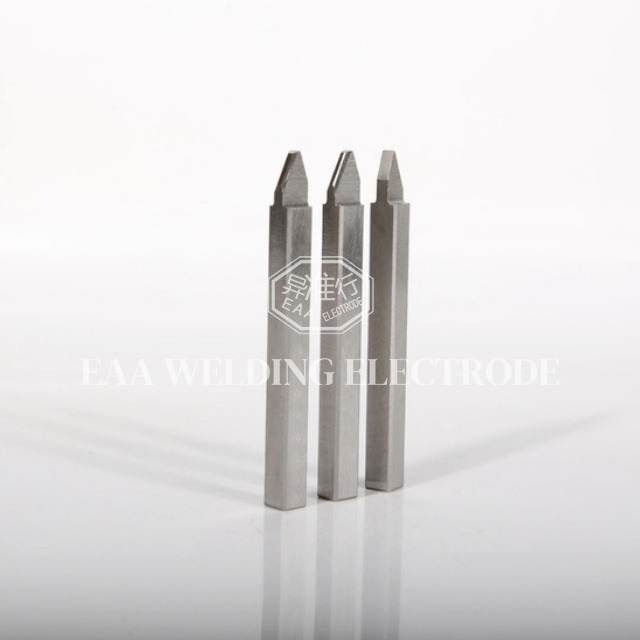
Deciding between solid electrodes and caps significantly shifts your maintenance budget. Straight or solid electrodes remain highly durable. They feature standard nose configurations (A through F). Facilities can easily water-cool them. They perform best for lower production volumes. They also work well for specialized access requirements where bulky adapters fail.
Caps and shanks serve as high-volume economic alternatives. The main shank is reused indefinitely across thousands of cycles. The minimal-volume cap uses either a male or female taper. Operators simply discard the small cap when worn. This modular approach dramatically lowers per-weld material waste. When moving to a cap-and-shank architecture, ensure your extraction tools match the taper. Using generic pliers to remove caps damages the shank taper, causing internal water leaks.
Alloy selection must scale based directly on thermal load. Move from standard Cr-Cu to Zr-Cu for coated steels. Zirconium resists zinc sticking much better than chromium alone. Specify Refractory Metal-Faced (Tungsten/Molybdenum) electrodes for extreme high-heat applications. You also need these specialized faces when welding highly conductive copper parts.
Evaluating a reputable Spot Welding Electrode manufacturer requires diligence. Look for suppliers offering highly traceable alloy metallurgy. You must avoid legacy health risks like Beryllium-Copper unless tightly controlled. Also, carefully assess their inventory depth for standard tapers. You should always partner with a Spot Welding Electrode manufacturer who guarantees supply chain resilience during peak production runs.
The life of a spot welding electrode serves as a direct reflection of a facility's process control. Achieving optimal performance requires moving past basic guesswork. It demands implementing strict, data-driven operational standards.
Monitor your cooling efficiency constantly to prevent thermal deformation and scaling.
Automate dressing schedules based on empirical destructive testing data rather than operator intuition.
Select the exact alloy and form factor suited specifically for your workpiece material.
Audit your current cooling flow rates and dressing frequencies today. You should consult with a specialized manufacturer to transition to a more efficient cap-and-shank system. Taking these actions will streamline your operations and secure reliable weld quality.
A: Mushrooming is the physical flattening and widening of the electrode tip caused by repeated heat and pressure. It is the primary cause of weld failure, as the widened tip dilutes the electrical current density over too large an area.
A: The zinc coating on galvanized steel melts at a lower temperature than the steel itself, alloying with the copper electrode. This creates a resistive layer that causes the electrode to stick, degrade, and require more frequent tip dressing.
A: This depends on the tip geometry (e.g., truncated cone vs. dome) and the depth of the cut. Typically, an electrode can undergo dozens of minor dressings before the remaining copper mass is insufficient to manage the thermal load.
A: While Beryllium-Copper offers exceptional hardness, it is increasingly phased out of standard operations due to the severe health and respiratory risks associated with beryllium dust generated during tip dressing. Chromium and Zirconium alloys are the modern industry standards.


