


Views: 0 Author: Site Editor Publish Time: 2026-03-20 Origin: Site


Many weld defects start before the arc begins, often with the wrong electrode choice. The right rod affects strength, penetration, arc stability, and cleanup. In this guide, you will learn how to choose electrodes by metal, position, and power source, and when a Resistance Welding Electrode is the better option.
The first step is to understand the base metal. Mild steel, low-alloy steel, stainless steel, cast iron, and non-ferrous metals do not respond the same way during welding. Each one needs an electrode that matches or closely supports its chemistry and mechanical behavior. If the filler does not match well, the weld may crack, corrode early, or fail under load.
A simple visual check can help. Mild steel is common in general fabrication and repair. Stainless steel usually needs matching stainless filler. Cast iron often needs specialty electrodes because it is brittle and sensitive to cracking. Aluminum and copper alloys bring their own challenges and usually do not use the same rod choices as steel. When the metal is uncertain, checking specifications or testing on scrap is safer than guessing.
Material thickness changes electrode choice quickly. Thin metal needs a softer arc and better heat control. Thick metal needs stronger penetration and often more ductility in the finished weld. If the part is heavy, restrained, or complex in shape, residual stress becomes more serious. In those cases, low-hydrogen electrodes are often the safer choice.
Part shape matters too. A flat plate is easier to weld than a corner, pipe, bracket, or built-up assembly. Heavy sections hold heat longer, while thin sections lose shape faster. The correct rod size and coating help balance heat input, bead shape, and crack resistance.
Joint design tells you how aggressive the arc needs to be. Tight joints or unprepared edges often need deeper penetration. Open roots and wider gaps often need a softer, more controllable arc that can bridge without falling through. A good electrode choice follows the real fit-up, not the drawing alone.
If the gap is tight and the root is not beveled, a digging arc may be necessary. If the joint has a wide opening or thin root edge, a milder arc can reduce burn-through and give better bead control. This is one reason why one electrode cannot do every job equally well.
The finished part may work in cold weather, high heat, vibration, impact, or corrosive service. That matters. A weld that looks good in the shop may still fail in the field if the electrode does not support the right ductility, toughness, or crack resistance.
Structural parts, pressure work, and equipment exposed to repeated shock often require low-hydrogen electrodes. Service conditions should be checked before the first rod is chosen, not after defects appear. Code requirements may also limit which electrodes can be used.
A good rule is to match the electrode strength to the base metal strength as closely as possible. If the rod is too weak, the weld may become the weak point in the joint. If it is too strong, the weld may become harder and less forgiving, which can increase cracking in some applications.
This is why AWS numbers matter. For example, a 60-series rod is generally used where about 60,000 psi tensile strength is suitable. A 70-series rod fits many structural steel applications. Matching strength is not only about numbers. It is also about how the weld cools and performs in service.
Not every rod runs well in every position. Some rods are easy to control in flat, horizontal, vertical, and overhead work. Others are mainly intended for flat and horizontal welding. Position affects slag movement, bead support, and how fast the puddle freezes.
A rod marked for all-position work gives more flexibility in field and repair jobs. For heavy shop work on flat parts, a higher-deposition rod may improve speed. Position is often one of the fastest ways to narrow the options.
Some electrodes work best on DC+, some on AC, and some can run on either. Choosing a rod that does not match the machine output leads to unstable arc performance, poor penetration, and unnecessary frustration. This is especially important for smaller shop machines and older equipment.
DC+ usually gives a more forceful arc and deeper penetration. AC-compatible rods are useful where AC power is the only option. Some general-purpose rods offer more flexibility for mixed shop conditions. Always check current compatibility before buying in bulk.
Penetration is important, but too much can damage thin material or create unnecessary spatter. Too little can leave lack of fusion and weak joints. Good electrode selection balances penetration with appearance, puddle control, and cleanup needs.
For dirty steel or tight roots, a more penetrating rod may be best. For thin sheet or appearance-sensitive repair work, a softer arc can give cleaner results. The correct choice depends on what the weld must do, not only on what it looks like.
Factor | What to Check | Why It Matters |
Base metal | Type and composition | Helps prevent cracking and corrosion |
Strength | Tensile match | Improves joint performance |
Position | Flat, vertical, overhead | Affects puddle control |
Current | AC, DC+, DC- | Controls arc behavior |
Thickness | Thin or thick section | Changes penetration needs |
Service | Heat, shock, code | Determines toughness needs |
AWS codes help welders read an electrode quickly. In a rod like E7018, the “E” means electrode. The first two digits often show tensile strength in thousands of psi. The next digit usually shows welding position. The last digits describe coating and current compatibility.
That means the code is not random. It tells you whether the rod is meant for all-position work, what current it prefers, and how strong the finished weld should be. Once you learn the pattern, electrode selection becomes much faster.
Flux coating changes how the arc feels and how the weld behaves. High-cellulose coatings support deep penetration and a forceful arc. Titania coatings often give a smoother, easier-running bead. Iron powder coatings can raise deposition rates. Low-hydrogen coatings improve crack resistance in critical work.
The coating also affects slag removal, arc smoothness, and tolerance to contamination. A beginner may prefer a rod that runs softly and cleans easily. A production welder may care more about deposition speed or penetration under imperfect fit-up.
Rod diameter matters almost as much as rod type. Smaller rods are better for thin material, root passes, and positional control. Larger rods deposit more metal and suit thicker sections or faster flat-position work. Using the wrong size can make a good rod perform badly.
A small rod on thick material may waste time and fail to penetrate enough. A large rod on thin material may burn through or create a rough bead. Diameter should always match both the part thickness and the machine’s amperage range.
Tungsten color codes matter in TIG welding because tungsten is a non-consumable electrode. Pure tungsten, thoriated, zirconiated, and lanthanated types behave differently under different currents and metals. This is a different system from stick rod selection, but it is still part of choosing welding electrodes correctly.
For many shops, this matters when they switch between TIG and SMAW work. Confusing tungsten selection with flux-coated rod selection can lead to poor results. Each process has its own logic.
Electrode | Typical Strength | Current | Common Use |
E6010 | 60 ksi | DC+ | Deep penetration, root passes |
E6011 | 60 ksi | AC/DC | Dirty metal, repair work |
E6013 | 60 ksi | AC/DC | Thin metal, light fabrication |
E7018 | 70 ksi | AC/DC depending on type | Structural and low-hydrogen work |
E7024 | 70 ksi | AC/DC | Flat, high-deposition welding |
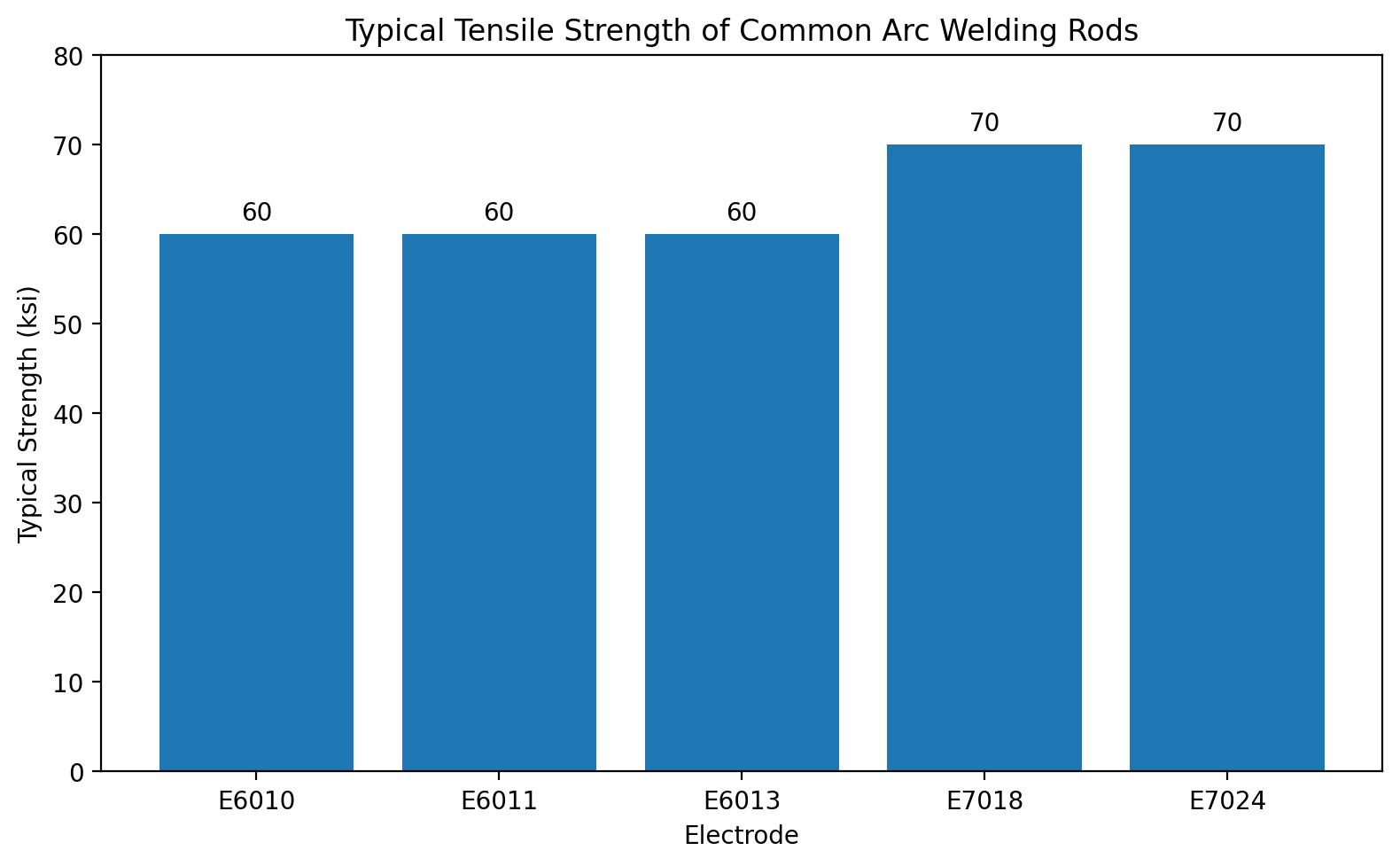
Mild steel is the most common material in general fabrication, repair, and shop work. E6011, E6013, and E7018 are common choices depending on fit-up, machine type, and strength needs. General repair may favor versatility, while structural jobs may favor low-hydrogen performance.
For routine work, the best choice is often the one that matches both the steel and the working conditions. A popular rod is not always the best rod. The real question is whether it suits the joint, the power source, and the service load.
Some rods tolerate contamination better than others. Deep-penetrating electrodes are often preferred when perfect cleaning is not practical. That does not mean surface preparation stops mattering, but it gives more flexibility on repair and field jobs.
If the material is heavily rusted or painted, cleaning should still be done as much as possible. A rod that can cut through some contamination is helpful, but it should not replace good preparation when quality matters.
Thin metal needs controlled heat and smoother arc behavior. Thick metal often needs stronger penetration, more ductility, and sometimes low-hydrogen performance. One of the biggest mistakes in welding is using the same size and type of rod on both extremes.
A light sheet and a heavy structural bracket do not need the same welding strategy. Changing rod size, flux type, and current compatibility is often necessary to get consistent results.
Critical joints often require low-hydrogen electrodes because they resist cracking better under restraint, impact, or code-controlled service. Structural steel, pressure systems, and safety-related fabrication often fall into this category.
These jobs reward discipline. Storage, moisture control, and procedure compliance matter more here than in simple repair work. The right electrode supports both weld quality and inspection success.
A Resistance Welding Electrode is used in a different process from stick or TIG rods. Instead of melting a filler rod into the joint, resistance welding uses pressure and electrical resistance to create heat at the interface. This makes it highly effective for sheet metal, repeatable spot welds, and fast production work.
If the job involves overlapping sheets, repetitive weld points, and controlled production speed, a Resistance Welding Electrode may be the better choice. It is especially common in automotive, appliance, and electrical manufacturing.
Resistance welding electrodes are often made from copper and copper alloys because they conduct heat and electricity very well. Some applications use copper-chromium, copper-beryllium, tungsten, molybdenum, or specialty blends where higher hardness or heat resistance is needed.
Material choice affects wear life, sticking risk, and weld consistency. A softer alloy may conduct well but wear faster. A harder alloy may last longer under force and heat. The best choice depends on the base material and the production cycle.
A Resistance Welding Electrode should be selected for the metal being welded, not only for machine compatibility. Steel, nickel alloys, copper alloys, and other conductive metals do not respond the same way. Using copper on copper, for example, can create sticking problems in some cases.
The goal is to balance conductivity, hardness, and heat control. A good match improves nugget formation, reduces sticking, and extends electrode life. In production environments, that can save both downtime and consumable cost.
Tip geometry is critical in resistance welding. It affects contact area, current density, nugget size, and wear rate. A smaller contact area increases heat concentration. A larger one spreads current and may reduce penetration.
This is why a Resistance Welding Electrode cannot be chosen by material alone. Shape and size must match the part design, thickness, and production target just as carefully as the alloy choice.
Many welders default to the rods they know best. That may work on familiar jobs, but it can cause defects on different metals or service conditions. A best-selling rod is not automatically the right rod.
Electrode choice should follow the job requirements. Popularity can guide a starting point, but it should never replace technical matching.
A strong rod choice can still fail if the machine setup is wrong. AC and DC mismatch causes unstable arcs, poor penetration, and wasted time. Always confirm machine output and recommended polarity before starting work.
Rod size changes deposition rate, puddle control, and penetration. Oversized rods are hard to control on thin parts. Undersized rods slow production and may fail to fuse thick sections properly. Size should always support the part thickness and current range.
Rod condition matters. Some low-hydrogen electrodes absorb moisture easily and can cause porosity or cracking if stored poorly. Storage practices are part of electrode selection because the right rod in bad condition is still the wrong rod for the job.
Start by checking the base metal and the section thickness. This removes incompatible options early. It also helps narrow the field to rods that can actually support the weld.
Next, look at weld position, fit-up, and machine current type. These practical conditions eliminate many wrong choices quickly. A rod must work in the real shop or field setup, not only in theory.
Then compare the joint’s real demands. Strength, impact, temperature, and code requirements may all affect the final choice. Low-hydrogen or specialty electrodes may become necessary at this stage.
Finally, run test coupons before full production. A short trial can reveal arc feel, bead shape, and cleanup needs. Once the best option is confirmed, standardize it for similar jobs to save time later.
Step | Question | Result |
1 | What metal and thickness is it? | Removes incompatible rods |
2 | What position and current are available? | Narrows usable options |
3 | What strength and service conditions apply? | Confirms final type |
4 | Does the test weld perform well? | Supports standardization |
Choosing the right electrode is about matching the rod to the real job, not simply reading product codes. Base metal, thickness, position, current, fit-up, and service conditions all influence weld quality, efficiency, and rework rates. The same principle applies to every Resistance Welding Electrode used in production welding. Guangzhou Yizhunxing International Trade Co., Ltd. offers dependable electrode solutions that improve consistency, reduce consumable waste, and support more efficient long-term welding operations.
A: Base metal, thickness, position, current, and service conditions should guide selection first.
A: Use a Resistance Welding Electrode for sheet overlap, repeatable spot welds, and fast production work.
A: They help reduce cracking in structural, restrained, or impact-loaded welding applications.
A: Proper Resistance Welding Electrode size reduces wear, sticking, rework, and downtime cost.


